



A lit mountain lodge-style home at night with evergreen trees, stone accents, and snow-capped mountains in the background.

Heat Pump Installation in Heber, UT

Tell us about the job

Takes about a minute. No obligation.

New system or replacementHeat PumpWasatch County, UT
Step 1 of 2

What ZIP code is the job in?

Gas heats 79.4% of homes in Wasatch County, so most heat pump installs here go in alongside an existing gas furnace rather than replacing it outright. The furnace stays for the coldest stretches of winter, and the heat pump takes over the rest of the year, handling both heating and cooling from one outdoor unit. That setup is worth asking about if your home already has gas ductwork in place, since it changes what the installation involves. Electricity heats a much smaller share of homes here, so a straight heat pump replacement with no backup furnace is less often what a contractor finds on arrival.

10 months
September through June, your system heats
14°F
the average winter night it heats against
75°F
the average summer afternoon it cools against
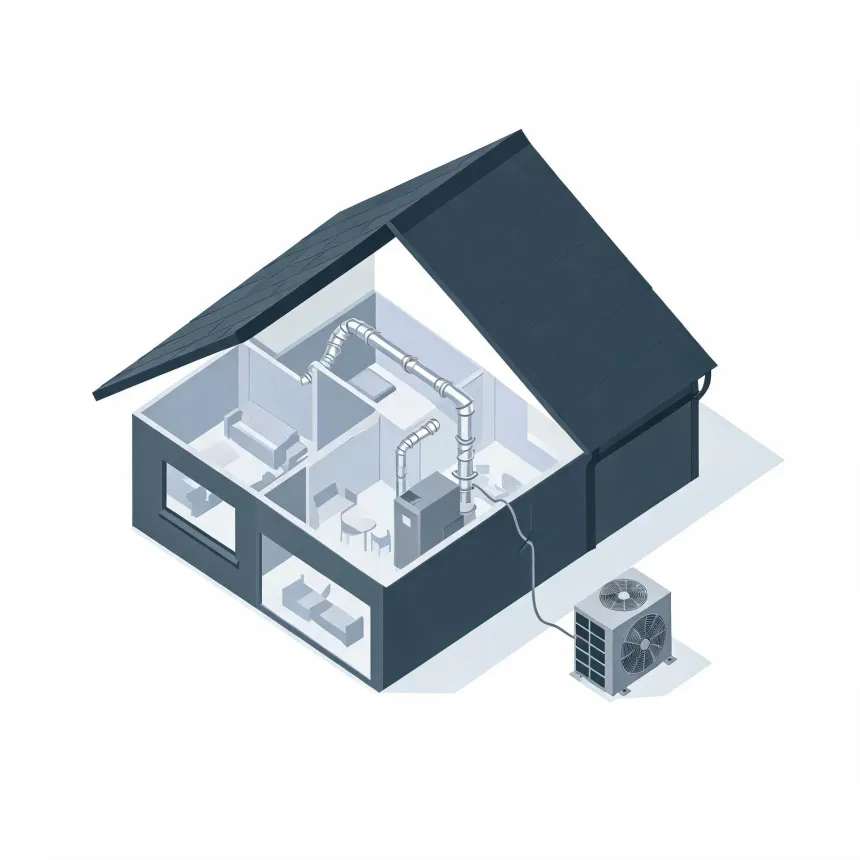
Isometric illustration of a cutaway house showing interior rooms with furniture, a furnace and ductwork, connected by a line to an outdoor condenser unit on the ground outside.

Every heat pump has a balance point, the outdoor temperature where it stops keeping up on its own.

Ask what takes over below that point. A furnace does the job differently than electric strip heat does.

Ten months of heat a year leaves a short window to install before September

Heat runs September through June
37 damaging wind events from 2015 to 2024
104 winter storms from 2015 to 2024

A standard heat pump sized to the house works fine in Heber, the same as it would anywhere else at this elevation. There's nothing about the altitude or the climate here that calls for an oversized unit or a premium cold-climate model over a regular one. Utah homes paid 12.22 cents per kilowatthour in 2024, a rate that doesn't push the math toward a bigger or more efficient unit than the house actually needs. Sizing still comes down to the home itself, its square footage, its insulation, how the ducts are laid out. Bigger isn't better here. It just costs more to buy and run.

A new heat pump here has to meet 14.3 SEER2 and 7.5 HSPF2

Wasatch County falls in climate zone 6B, and any split-system heat pump installed here has to clear 14.3 SEER2 for cooling and 7.5 HSPF2 for heating. That's the federal floor, not a local add-on, so it narrows the field before a contractor ever talks sizing with you. Worth confirming the equipment on your quote actually meets it.

Find a contractor
A gray heat pump outdoor unit mounted on a concrete pad next to a residential house with lap siding and stone accents.

Right-sized runs steady. Oversized just cycles harder.

A contractor works out size with a load calculation, not a tape measure on the old unit. That means walking the house. Square footage, how many windows face which way, how much insulation is in the attic, how many people usually fill the rooms. Skip that step and the guess tends to run big, since bigger feels safer. It isn't. An oversized heat pump cools the air fast and shuts off before it pulls the moisture out, so the house feels clammy even at the right temperature. It also cycles on and off more, and every start wears on the compressor more than running steady does. Undersized has its own problem. It runs flat out and still can't hold the line on the coldest or hottest days. The right size runs long, steady stretches, which is exactly how these units are meant to run. Ductwork matters just as much as the unit itself. A system sized right for the house but choked by old, narrow ducts won't move the air it's rated for, so the room farthest from the air handler ends up warm in summer and cold in winter no matter what's bolted outside.

The old furnace usually stays put

If the install is a heat pump working alongside your furnace, the furnace doesn't go anywhere. It stays in the ductwork as backup for the coldest days and sits idle the rest of the year. Nothing gets disconnected or hauled out.

A straight swap is a different job

If what's being replaced is an old air conditioner or an all-electric setup, that outdoor unit comes out. The condenser gets disconnected, the refrigerant recovered, and the old unit hauled away before the new one goes on the pad. Ask which job you're actually getting quoted.

A few things push the price around more than the unit itself. Where the outdoor unit sits matters, since running new refrigerant line to a spot far from the old condenser pad takes more labor than setting it close by. The electrical panel matters too. A heat pump pulls more power than the gas furnace it's pairing with, and if the panel's already full, adding the circuit means more work before the unit ever gets mounted. Ductwork is another one. If the existing ducts are the right size and in good shape, the indoor part of the job goes fast. If they're undersized or leaky, a contractor either has to recommend fixing that first or tell you the new system won't deliver what it's rated for. And if the job is a heat pump paired with the existing furnace, that pairing needs a control board that can run both and switch between them, which is its own part and its own labor. None of that shows up on the unit's price tag, but all of it shows up on the invoice.

Install day starts outside. The old condenser gets disconnected, the line set drained of refrigerant, and the unit lifted off the pad before anything new goes in. Indoors, if the job is a straight swap, the air handler or coil comes out too. If the heat pump is pairing with an existing furnace, that part of the system stays put and gets wired into a new control board instead. The electrical work usually takes longer than people expect. The panel needs a dedicated circuit sized for the new unit, not just a tie into whatever fed the old one. Once the new condenser is set and leveled, the line set gets brazed, pressure tested, and pulled down to a vacuum before any refrigerant goes in. That step is what keeps moisture and air out of the system for the long run. The last stretch is all checks. Airflow at each vent, refrigerant charge against the manufacturer's numbers, the thermostat talking to the right equipment. A job that looks finished with the unit sitting outside isn't actually done until those checks are run.