Most homes here run on gas
Utility gas heats 67.8% of homes in Millard County. Electricity and bottled or LP gas each heat a much smaller share.
Takes about a minute. No obligation.
Utility gas heats 67.8% of homes in Millard County. Electricity and bottled or LP gas each heat a much smaller share.
If your house heats with gas now, installing a heat pump means weighing it against that gas furnace instead of swapping one unit for the same kind. The contractor sizing the job needs to know what's there now, gas, electric or LP, to tell you what fits.
NOAA nClimDiv, 1991–2020 normals
Half the homes in Millard County were built in 1974 or earlier, half later.
No era of house here needs an oversized or special-order heat pump, a standard unit sized to the home fits.




Heat here runs October through May, eight months out of the year. September is the month before that starts, and it's the better time to put in a heat pump than waiting until the cold shows up. A contractor installing in September has room to set the charge right and check how it ties into the ductwork already there, without you going without heat while that happens. Wait until the system that's failing finally quits in the cold months and you're picking from whoever can get there fastest with whatever unit they have on the truck. Cooling only runs June through August here, so late summer into September is slow season for install crews, which works in your favor for scheduling.
Zone 5B calls for a split-system heat pump rated at least 14.3 SEER2 and 7.5 HSPF2. That's the federal minimum for units built from 2023 on, and it's what a contractor sizing your install has to work with here. A federal tax credit is available on qualifying heat pump installations, worth asking about when you compare quotes.
Find a contractorA heat pump here cycles on and off with whatever the day calls for, not against a steady beating from wind or storms. It still needs to be sized to your house, not oversized to cover a worst case that already came and went without taking anything down.
A heat pump installation usually means pulling the old equipment, not leaving it in place as backup. If gas heat is being replaced, the furnace gets disconnected and removed, and the gas line serving it gets capped off by whoever is qualified to do that. An old outdoor AC unit comes out too, along with its pad and line set if they're not being reused.
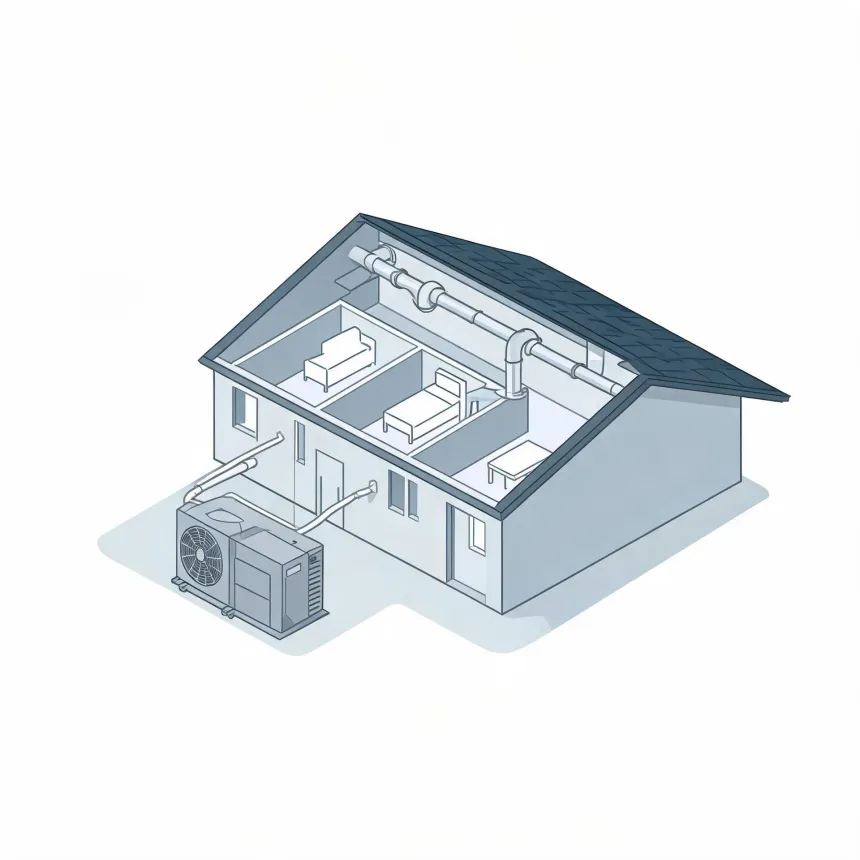
If the house already has ducts, a heat pump can often use them, and the contractor will check whether they're sized right for the airflow a heat pump moves. The indoor air handler or coil tied to the old system usually gets swapped for one that matches the new equipment. None of that gets decided until someone looks at what's actually running through the walls now.
Sizing a heat pump comes down to a load calculation, not a guess based on the old unit or the square footage alone. A contractor measures the house. The windows, the insulation, how the rooms are laid out, what direction the walls face. From that they work out how much heat the house loses on a cold day and gains on a hot one. Too big and the unit short cycles, running a few minutes at a time, shutting off before it pulls moisture out of the air, then kicking back on. Too small and it runs flat out on the coldest and hottest days and still can't keep up. Either mistake wears the compressor down faster than running it at the size it was built for. The old equipment being a certain size doesn't mean that's the right size to install again, especially if anything about the house changed since it went in.
Install day starts with the old equipment coming out and the new lines going in, and most of the time goes to things you won't see once it's buttoned up. The refrigerant lines get run between the outdoor unit and the indoor coil, and those joints get brazed, not just fitted together. Once the system is sealed, it gets pressure tested to make sure nothing leaks before any refrigerant goes in. Then it gets evacuated with a vacuum pump to pull out air and moisture, because either one left in the lines will damage the compressor over time. Only after that does the system get charged, and the charge gets weighed in or checked against the manufacturer's numbers rather than eyeballed. The last part is running the system through a full cycle, heat and cool, and checking the airflow at the vents matches what the equipment is supposed to move.