


An unfinished basement interior showing a gray furnace unit beneath a bare incandescent bulb, surrounded by exposed joists, concrete walls, cardboard boxes, and utility pipes.

Furnace Maintenance in Delta, UT

Tell us about the job

Takes about a minute. No obligation.

Tune-up, service, or cleaningFurnace or heatingMillard County, UT
Step 1 of 2

What ZIP code is the job in?

A quick tune-up means someone glances at the furnace, listens to it run, and leaves. A thorough one means the panels come off. The tech checks the flame through the viewing port, looking for a steady blue burn rather than one that flickers yellow or lifts off the burner. The flame sensor gets cleaned or tested, since a dirty one is behind most nuisance shutdowns. The heat exchanger gets inspected for cracks, because a cracked one can let exhaust mix with the air headed into your rooms. The blower wheel gets checked for dust buildup, which throws off airflow even when the motor sounds fine. Someone who skips the cover panels isn't seeing any of that, no matter how good the furnace sounds while it's running.

Half the homes in Millard County were built in 1974 or earlier, half after.

Old furnace or new, once a year is what the checkup needs. The age doesn't change the schedule.

Most of Delta heats with gas, so the burner and venting are what maintenance here is really about

67.8% of homes heat with gas
Heat runs October through May
Winter nights average 20°F

Furnace here runs eight months a year, October through May. September is the month to get it checked, before it has to carry that load. Wait until the first cold night and you are finding out about a bad igniter when you need the heat most, not before. A tune-up in September catches that kind of problem while there is still time to fix it on your schedule instead of the furnace's.

Once a year is what this furnace needs

Gas cost $12.55 per million Btu in Utah in 2024, and your furnace is what turns that gas into heat for your home. That is reason enough to keep it running the way it should, not more than it has to. One checkup a year covers that. It does not need to be checked more often than that to catch a worn part before it fails.

Find a contractor
A gray high-efficiency gas furnace installed in an unfinished basement, surrounded by gas lines, a condensate drain, and sheet-metal ductwork.

What you can check yourself, and what to leave alone

Between visits, the filter is the one thing worth checking yourself. A dirty filter chokes airflow, and a furnace starved for air runs hotter than it should and shuts down more than it needs to. Pull it out, hold it up to a light. If you can't see through it, swap it. Keep the area around the furnace clear too. Boxes, laundry, anything stacked against it blocks the air it needs to breathe. Listen while it runs. A new rattle, a bang when it kicks on, a smell that wasn't there before, any of that is worth a call rather than a wait. What you shouldn't do is open the cabinet. The panels come off for a tune-up because that's a job for someone who knows what a cracked heat exchanger or a lifting flame looks like. Between checkups, the filter and your ears are the whole job.

The filter is doing more than cleaning the air

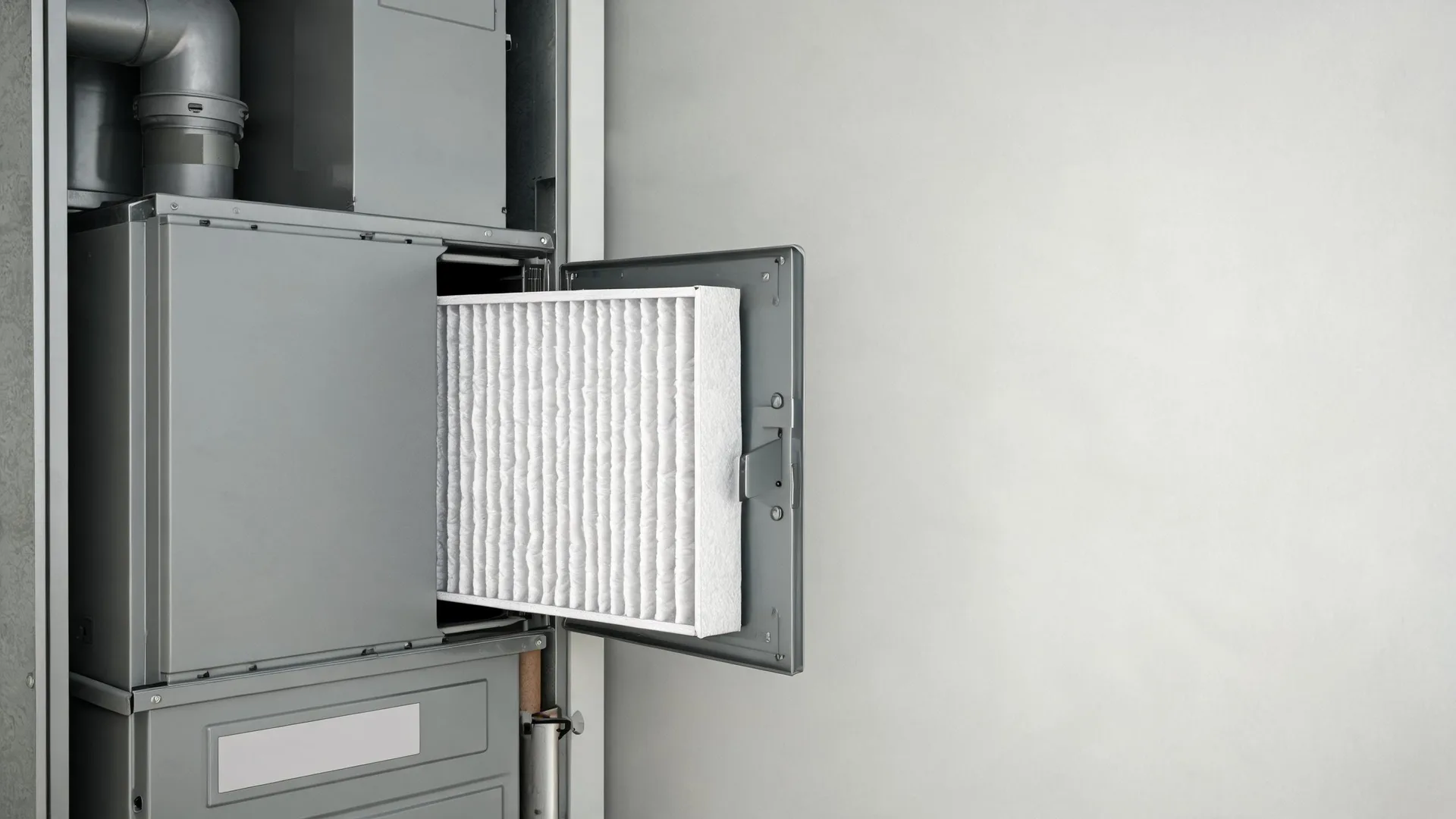
A clogged filter chokes the air your furnace needs to run. Starved for air, the heat exchanger runs hotter than it was built for, and the furnace will start shutting itself off on high limit to protect itself. Left long enough, that kind of heat stress is what cracks an exchanger. The coil and drain you can mostly leave to the tune-up, but the filter is worth checking on your own between visits.
A cracked exchanger is the failure that matters most

The coil in a furnace carries the exhaust and heat exchange, and once it cracks, it does not fix itself and it does not get better on its own. A crack lets exhaust gas leak into the air your blower pushes through the house instead of out the vent. That is why a tune-up means pulling the panels and actually inspecting the exchanger, not just listening to the furnace run. Catching it early is the whole reason for the yearly check.

A pressure switch that reads fine sitting still can still fail once the inducer motor spins up, and you only catch that by running the furnace through a full cycle, not by glancing at it. Same with a gas valve. It can open and close the way it should on a mild day and still struggle once the burner has to hold a steady flame for hours. Amp draw on the blower motor is another one nobody checks from the next room. A motor pulling more current than it should will run for a while yet, but it's working harder to do it, and that shows up on a meter long before it shows up as a breakdown. None of this is guesswork. It's reading what the furnace is actually doing while it runs, not just whether it starts.

A tune-up also means checking the venting, not just the burner. Gas furnaces push exhaust out through a flue or a sidewall vent, and that path has to be clear and sloped the way it was installed. A tech checks for rust at the joints, for a vent pipe pulling apart at a seam, for anything blocking the termination outside. Combustion air matters too. The furnace needs a supply of fresh air to burn gas cleanly, and a room that's been sealed up tighter since the furnace went in can starve it. Gas pressure gets checked at the valve, because too low and the burner struggles to heat properly, too high and it can crack the heat exchanger over time. None of that shows up by watching the furnace run. It shows up on a manometer and a flashlight, which is the whole reason the panels come off.