Your new furnace project goes to an installer who works in Tooele County.
A furnace in Tooele County gets asked to do real work. Winters here are cold, and most homes run on gas to get through them. That furnace cycles on more nights than not from fall through spring, and how long it holds up depends on how it was installed, how it's been maintained, and a few things you can check yourself.
If you're trying to figure out whether your furnace has years left or whether you're looking at a replacement, the make, model and install date on the unit itself tell you more than any general rule does. So does whether it's been serviced on any kind of schedule.
Most of the work in this situation isn't the furnace question itself. It's finding someone who'll actually look at your unit, tell you straight whether it's worth repairing again or time to replace it, and give you a number you can trust. That usually means calling a few places, explaining the same problem three or four times, waiting on quotes that don't line up with each other, and trying to judge who's being straight with you and who's padding the estimate.
This page exists to skip that part. When you put in your information, it goes to a contractor who installs furnaces in the Tooele area and knows what the winters here ask of a heating system. They reach out to you directly. No guarantee on what they'll quote or what they'll find once they're looking at your furnace, but you won't be the one doing the legwork to find them.
What's below walks through how long furnaces typically hold up, what shortens that, and what to watch for as yours ages. The answer isn't the same for every house or every install. But the signs are worth knowing before you decide what to do next.
A gas furnace in Tooele County typically lasts between 15 and 20 years. Furnaces wear out from the inside, mostly in the heat exchanger, the part that cracks after thousands of cycles of heating up and cooling down. Because winters here send that furnace through months of hard, steady use, a unit that's skipped regular service or was sized wrong for the house can fall short of that range, while one that's been maintained well can run past 20. Past the 15 year mark, parts get harder to find, and a repair bill on an old furnace is worth weighing against the cost of a new one. If your furnace came with the house and you don't know its age, the data plate inside the access panel will have a manufacture date. That one number tells you more about what to expect next than anything else about the unit.
Why does a Tooele County furnace wear out as fast as it does?
Winter nights average 20°F
Winter nights average 20°F here. That cold keeps the burners firing for hours at a stretch instead of a few short cycles, and every hour adds to the wear on the heat exchanger.
Heat runs October through May
Heat runs October through May in Tooele County. Eight months of cycling on and off is more strain than a furnace in a milder climate ever sees in a year.
77% of homes heat with gas
77% of homes in Tooele County heat with gas. That means the heat exchanger, not an electric element, is the part doing the work and the part that eventually cracks.
NOAA nClimDiv 1991-2020 · ACS 2020-2024
Running the way it should
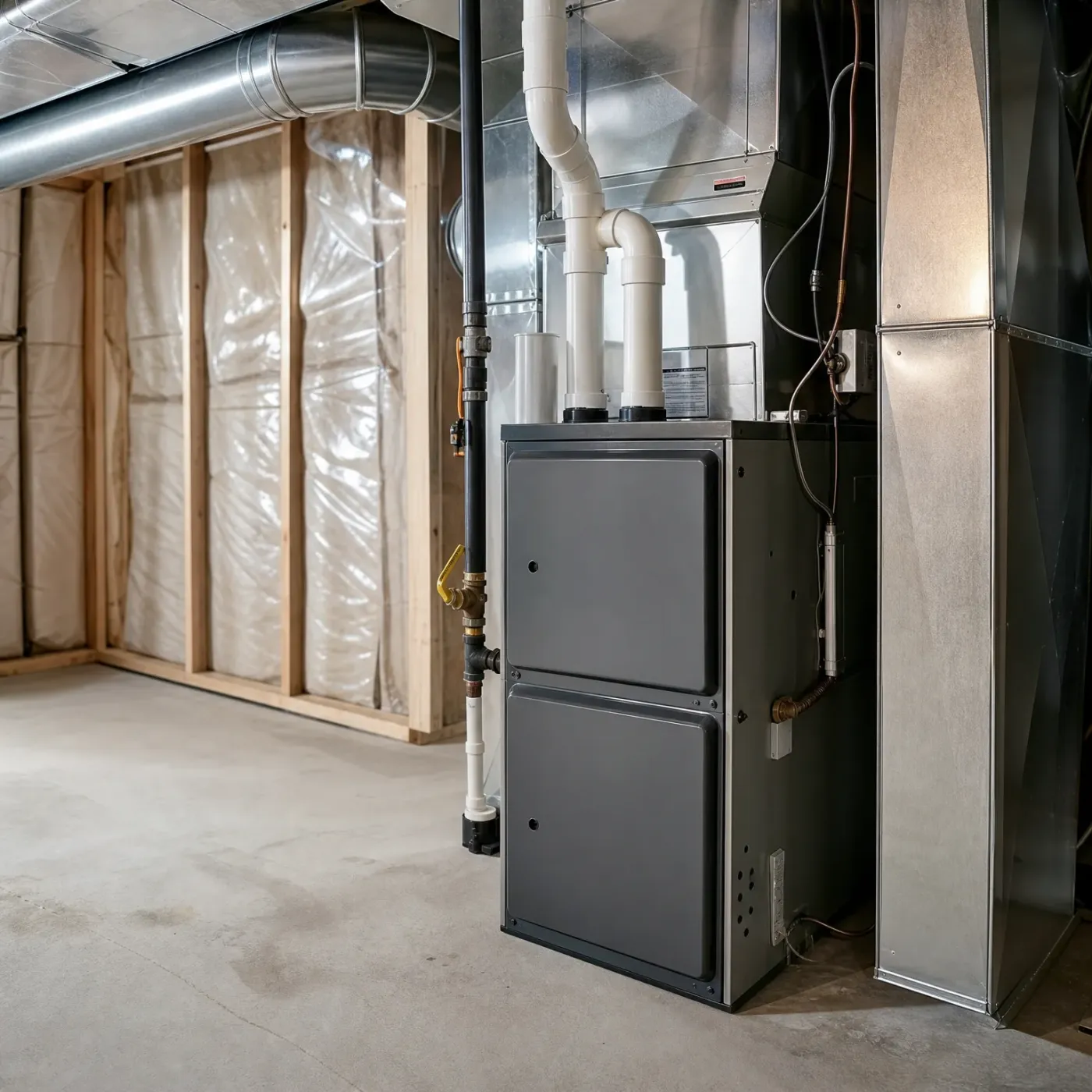
This is a furnace doing its job. The ducts are sealed to it, the flue pipes vent straight out, and the gas line feeds it clean. Nothing here is fighting the cold. A setup like this holds up for the full stretch, often past 15 years, because nothing around it is working against it.
Sitting on a pallet
A furnace propped on a wooden pallet usually means something below it failed once, water, a cracked drain pan, a flood from somewhere else in the house. That pallet is a patch, not a fix. A furnace that's already been through water damage once is closer to the end of its 15 to 20 years than its start.
Is your furnace telling you it's on its way out
A furnace nearing the end usually says so before it quits. You'll hear it click a few times before the burners catch, or run longer than it used to just to hold the house at temperature. Some rooms stay cooler than others. The air coming out of the vents feels thinner, not as warm. You might notice a faint burning smell when it first kicks on, or the burner flame looking yellow instead of blue. The gas bill climbs even though you haven't changed the thermostat. None of this means it's done, but a furnace working that hard through a Tooele winter is one cracked heat exchanger away from leaving you without heat on a cold night.
Get the right pro for your furnace
Skip collecting and comparing quotes for the new furnace.
A local installer who puts in furnaces gets your project.
A furnace like this still fires clean and heats evenly, with years of Tooele winters left in it.
Rust on the cabinet and aging PVC venting are signs this furnace is closer to the end than the start.
How a Furnace Actually Heats Your House
Gas flows to the burners first, and a hot surface igniter or spark lights them in under a second.
Burner flame heats the heat exchanger, a folded metal chamber that transfers heat without mixing flue gas into the air you breathe.
A blower motor pulls house air across the outside of that hot exchanger and pushes it back out through the ducts.
A flame sensor watches the burner the whole time it runs and shuts the gas valve if the flame ever drops out.
The inducer motor runs before the burners light, clearing the exchanger of old gas so the flue draws properly.
Once the thermostat is satisfied, the burners cut off first and the blower keeps running a short while to pull the last heat out of the exchanger.
A furnace cycle has an order to it, and every step matters to how long the unit lasts. The inducer motor starts first, clearing out any leftover gas from the heat exchanger so the flue draws correctly once the burners light. Gas reaches the burners and a hot surface igniter sets them off in under a second. No standing pilot stays lit waiting for that signal. Once the burners are firing, a flame sensor watches them the entire time. If the flame drops out for any reason, the sensor shuts the gas valve before unburned gas can build up. The burner flame itself never touches the air that reaches your rooms. It heats a heat exchanger, a folded metal chamber, and the blower motor pulls air from the house across the outside of that hot metal, then pushes it back through the ducts. The flue gas stays on one side, your house air on the other, and that separation is the whole point of the exchanger. When the thermostat is satisfied, the burners shut off first, but the blower keeps running a short while longer, pulling the remaining heat off the exchanger instead of letting it go to waste up the flue. That last detail matters here more than in milder places. A furnace in Tooele County runs this full cycle many times a night through the winter, and the heat exchanger is what takes the wear each time it heats up and cools back down.
15 to 20 years, less if the furnace has been fighting the house the whole time
A furnace in Tooele County that's sealed up right and sized for the house will get you 15 to 20 years of cold nights in the 20s without much drama. One that's been drawing air through a cracked duct or venting through old PVC will give out sooner, no matter what the brand name on the front says. The difference isn't luck. It's installation, and how the system has been looked after since.
If yours is creeping past 15 years, or doing any of the things covered above, the question isn't really how much time is left. It's whether you want to find that out the hard way, on a night when it's 20°F outside. Getting a furnace looked at now means one visit from someone who knows what to check, instead of you calling around Tooele County trying to find someone free the same week your heat quits.
Furnace Installation
A pro who works on furnaces
Your request goes to a Tooele County pro who takes furnace jobs.
Get matched with someone who does this kind of work in Tooele County.
Send the form and stop researching installers for the new furnace.
One request ends the search for a furnace installer.
Describe the project once instead of to every installer.
Skip searching for a furnace pro and answer a few questions instead.
A licensed installer who works in Tooele County gets your project.
One installer gets your project, so there's no bidding war over it.