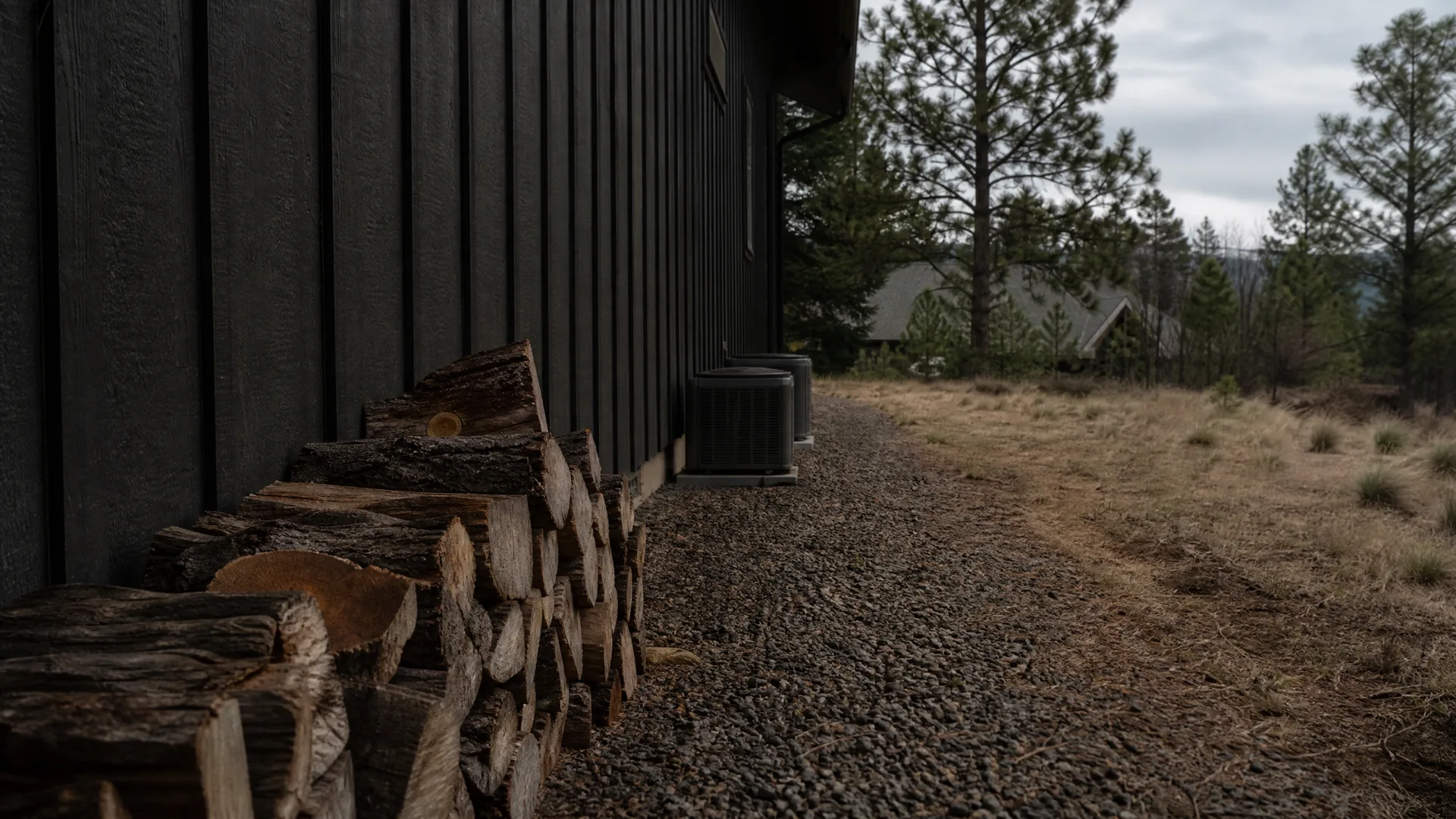







Stacked firewood along the dark vertical-board exterior wall of a house, with two outdoor condenser units, a gravel path, dry grass and pine trees under an overcast sky.

Heat Pump Repair in Tooele, UT

Tell us about the job

Takes about a minute. No obligation.

RepairHeat PumpTooele County, UT
Step 1 of 2

What ZIP code is the job in?

Winter nights in Tooele County average 20°F, cold enough that a heat pump leans on its backup heat strips more than some homeowners expect. That part is normal. If the system can't keep up, or it's blowing cool air, or it's running nonstop without catching up to the thermostat, the cause is usually something a tech sees all the time. A low charge. A failing defrost sensor. A reversing valve stuck in one position. Winter storms have hit the county 14 times in the last ten years, which doesn't point to any unusual strain on the equipment itself. Most of what goes wrong with a heat pump here is the same thing that goes wrong with one anywhere, and it gets fixed the same way.

8 months
October through May, your system heats
3 months
June through August, it cools
20°F
the average winter night it heats against
89°F
the average summer afternoon it cools against
Isometric cutaway illustration of a single-story house showing interior rooms with ductwork, an indoor air handler unit, and an outdoor condenser unit connected by lines along the exterior wall.
Your system heats October through May and cools June through August.

NOAA nClimDiv, 1991–2020 normals

Heat pumps here switch over to cooling in June and back to heat in October.

A part that was already weak usually gives out in the first cold snap after that October switch.

Tooele's weather doesn't stand out, and most heat pump trouble here doesn't either

518 severe weather events from 2015 to 2024
7% of homes statewide lost power a day or more in 2024
497 damaging wind events from 2015 to 2024
A county built on newer homesHalf the homes in Tooele County were built in 1998 or later.

Utah homeowners paid 12.22 cents per kilowatthour in 2024, which matters more with a heat pump than with a gas furnace, since the heat pump runs on electricity for both heat and cooling. A unit losing its charge or stuck running backup strips costs more to run long before it stops working outright, so a higher bill is often the first sign something is wrong. That's a reason to get a tech out when the system seems to be working harder than it used to, not just when it quits.

A newer system is a system worth repairing

A heat pump that came with a newer house still has most of its working life ahead of it. If yours is acting up, that points toward getting it fixed, not replaced.

Find a contractor
A man in a dark shirt and brown work pants, seen from behind, carries a worn canvas tool bag up porch steps toward a dark front door, with a potted shrub to the right.
A dark gray heat pump unit mounted on a concrete pad next to a house with gray siding and a stone veneer wall.

What you can check before the tech shows up

Before anyone comes out, check the thermostat batteries and make sure it's set to heat, not cool or fan only. Look at the outdoor unit. If the coil is caked in ice or buried in snow, that's worth noting, but don't chip at it or spray it with water. Go to the indoor air handler and pull the filter. A filter clogged with dust chokes airflow and can make the system run constantly without catching up. Check that supply vents around the house are open and not blocked by furniture or rugs. Look at the breaker panel for a tripped breaker, especially if the system isn't running at all. None of this tells you what's actually wrong inside the unit, but it rules out the easy stuff before a tech has to.

A low charge gets worse, not better

A heat pump low on refrigerant doesn't hold steady. The compressor keeps working against a charge it doesn't have, and that strain shortens its life. What started as weak heat on a cold morning can end with a compressor that needs replacing instead of a line that needs sealing and recharging.
Backup heat strips cover for a problem you can't see

When a heat pump can't pull enough heat from outside, the strips kick in and the house stays warm anyway. That's exactly why a failing reversing valve or a weak compressor can run for weeks without anyone noticing. The strips hide the failure until it's gone far enough that the fix is bigger than it would have been.

A heat pump fails the same handful of ways no matter whose yard it's in. The reversing valve sticks, so the system gets stuck heating or stuck cooling and won't switch. The defrost sensor goes bad, so the outdoor coil ices over and nothing tells the system to clear it. Refrigerant leaks out slowly at a fitting or a coil pinhole, and the compressor keeps running anyway, straining against a charge that isn't there. Contactors and capacitors wear out from just being cycled on and off thousands of times, the same as they would in an AC. None of this is about where the unit sits. It's about how many hours it's run and how long since anyone opened it up to look.

A diagnostic starts outside, with gauges on the service ports to check the charge and see how the system is running under its actual pressures, not just guesses from the thermostat. From there a tech checks the compressor amp draw against what it should be, tests the reversing valve to see if it actually shifts when told to, and checks the defrost board and sensor since a false reading there is what leaves a coil iced over. Inside, the tech checks the air handler, the blower wheel, and the strips themselves, since a strip that's stuck on will run constantly without anyone noticing from the thermostat alone. Most of this gets answered with a meter and a set of gauges, not by guessing from how the house feels. A tech who's done this a while usually has a good idea what's wrong within the first few minutes, but checks it against the readings before saying so.