







Illuminated timber-frame and stone houses along a residential street at night, with snow-capped mountains visible in the background.

Heat Pump Repair in Panguitch, UT

Tell us about the job

Takes about a minute. No obligation.

RepairHeat PumpGarfield County, UT
Step 1 of 2

What ZIP code is the job in?

Half the homes in Garfield County were built in 1982 or later. If yours is one of them, the heat pump giving you trouble may not be as old as it feels. A unit installed with a newer build still has working life ahead of it, and a repair now is usually the better call than starting over with a new system. Worth checking what came with your house before you decide which way to go.

8 months
October through May, your system heats
3 months
June through August, it cools
20°F
the average winter night it heats against
83°F
the average summer afternoon it cools against
Isometric grayscale illustration of a cutaway house showing interior rooms, ductwork and an indoor air handler connected by lines to an outdoor condenser unit on the ground outside.
Your system heats October through May and cools June through August.

NOAA nClimDiv, 1991–2020 normals

Panguitch winters bring heavy snow and cold air, not the kind of heat load that wears a heat pump down fast.

A heat pump here is more likely worn by age than beat up by the work, so fixing what's wrong usually makes sense.

Nothing here works your heat pump harder than normal

Power costs 12.22 cents a kWh statewide
22 damaging wind events from 2015 to 2024
6 hail events from 2015 to 2024
September is when it's worth a lookHeat runs October through May here. A part that's been weak all year tends to show itself in that first stretch of cold.

A repair call starts with a look at the nameplate, the model and serial number on the unit itself. That tells a contractor the age for certain, no guessing involved. If the number comes back low, parts are easier to get and the fix is usually straightforward. Worth having that number ready before anyone comes out, even just a photo of the tag.

Get the heat pump looked at, not replaced

Nothing you've read here points to a system worn out from overwork. If it's acting up, that's a reason to have it checked and fixed, not swapped out. Get someone out to look at it.

Find a contractor
A man in a dark long-sleeved shirt and olive work pants carries a canvas tool bag up steps toward a blue-gray front door of a shingled house, with a potted shrub beside the entry.
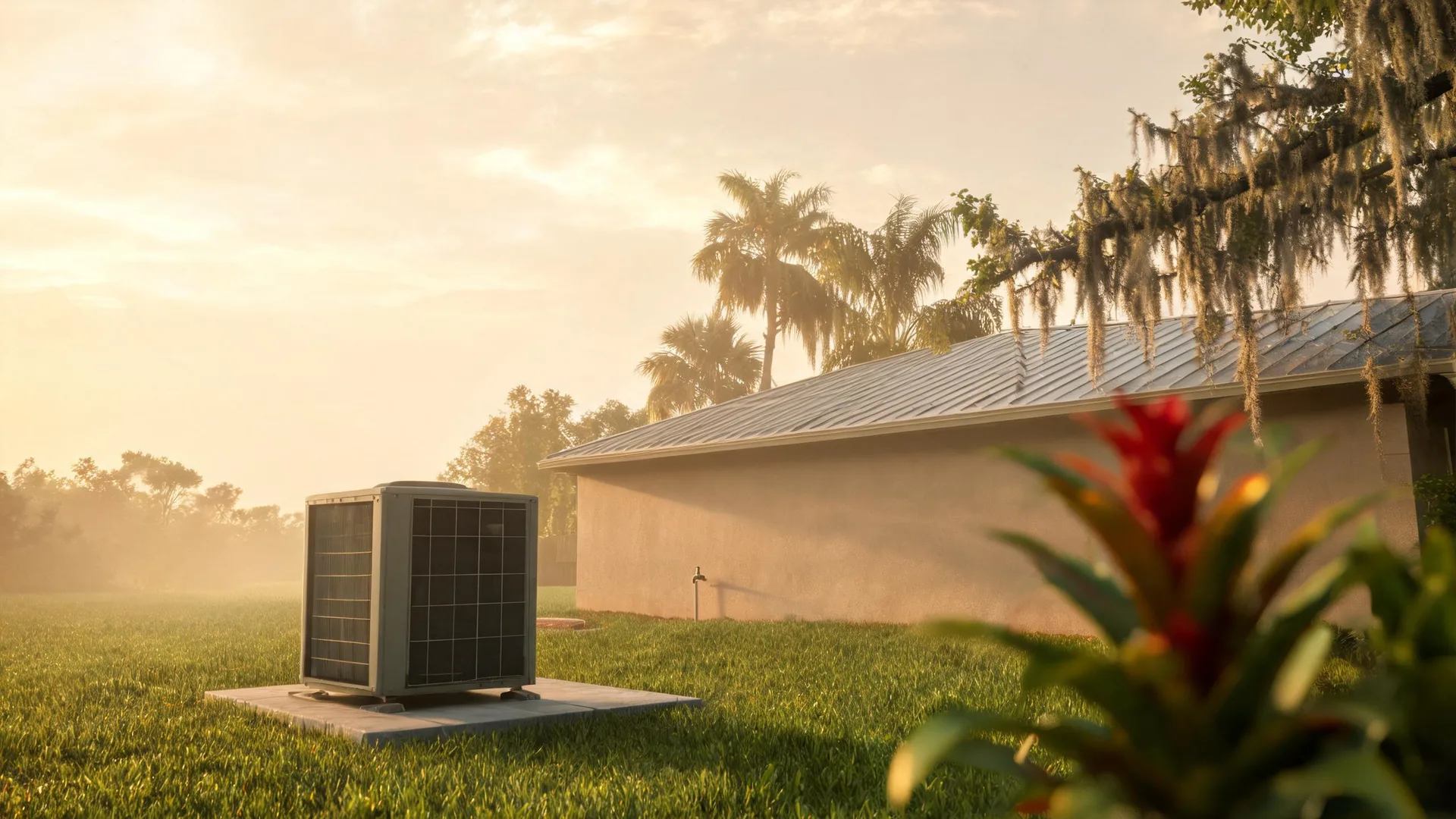
A gray heat pump outdoor unit mounted on a concrete pad next to the stone-accented exterior wall of a house.

What a failing heat pump actually does

A heat pump works both sides of the year, so trouble can show up in either mode. In heating, listen for it running long stretches without the air ever feeling warm. Check the outdoor unit for ice that builds up and never clears, even after the defrost cycle runs. In cooling, weak airflow from the vents is a common sign, and so is short cycling, where the unit kicks on and off in quick bursts instead of running a normal cycle. A hissing or gurgling sound from the lines points to refrigerant trouble. Any of these left alone tends to wear on the parts around it, so a unit that's been acting up for a while is worth more urgency, not less.

Check the filter first

A dirty filter chokes airflow across the indoor coil, and a heat pump reads that as a reason to run longer and work harder. Pull it and hold it up to a light. If light barely gets through, that alone could explain weak heat or short cycling. Clearing or replacing it is something to rule out before anything else.
Look at the thermostat and the breaker

Make sure the thermostat is set to heat, not fan only, and that the set point is actually above room temperature. Then check the breaker panel for the outdoor unit and the air handler. A tripped breaker or a thermostat set wrong looks exactly like a failed system from inside the house, and neither one needs a contractor to fix.

A diagnostic visit starts before any panel comes off. A contractor asks what the system is doing, when it started, and whether it happens in heating, cooling, or both. That narrows things down before a single tool comes out. Next comes a check of pressures and temperatures, airflow at the vents, and the condition of the outdoor coil. Electrical readings on the compressor and fan motor usually follow, since a motor can run weak long before it quits outright. The visit ends with a clear answer. What part is failing, what it takes to fix it, and whether that repair makes sense given what else is going on with the unit.

Repair or replace usually comes down to the compressor. Everything else on a heat pump, the fan motor, the defrost board, the reversing valve, gets replaced on its own without touching the rest of the system. The compressor is different. It costs enough on its own that a contractor will weigh it against a new system rather than just fixing it. So the real question when a heat pump is acting up isn't the age of the unit by itself. It's whether the problem is one of the parts around the compressor, which is a normal repair, or the compressor itself, which is the one failure that makes replacement worth a real conversation.