


An unfinished basement interior featuring a large metal furnace unit, exposed ceiling joists, concrete walls, and scattered boxes and cables on the floor.

Furnace Repair in Panguitch, UT

Tell us about the job

Takes about a minute. No obligation.

RepairFurnace or heatingGarfield County, UT
Step 1 of 2

What ZIP code is the job in?

Furnaces in Garfield County run from October through May, eight months of the year. Overnight lows through December, January and February average 20°F, and winter here means real snow and ice, not just cold air. A furnace covering that much of the year, against that kind of cold, works harder than one in most parts of the country. That kind of use wears an igniter or a blower motor sooner than you'd expect. If yours is short cycling, blowing cool air, or making a noise it didn't used to make, there's usually a specific reason, not just old age.

8 months
October through May, your furnace is on duty
20°F
the average winter night it heats against
43 winter storms
in ten years, the nights a failure hurts most
Isometric cutaway illustration of a small house showing a furnace unit connected to ductwork running through the interior and attic, with a chimney on the shingled roof and simple furniture in the rooms.
Your furnace works hardest from November through March.

NOAA nClimDiv, 1991–2020 normals

Electricity in Utah ran $35.80 per million Btu in 2024.

A furnace that's short cycling or struggling burns through that every month it runs.

Eight months of heat a yearFurnaces here run October through May, and trouble tends to start in September, the month before.

A furnace that's working this hard doesn't fail for no reason. Something that was already marginal, a cracked heat exchanger, a weak capacitor, a sensor reading wrong, is what gives out when a storm sits over Panguitch and the blower runs most of the night. Guessing at the fix wastes a trip and leaves the real problem underneath. A contractor who checks the actual part, not just the thermostat setting, finds out which one it is before replacing anything. That's what makes a repair hold through the rest of the winter.

A furnace burning money is still burning money tomorrow

A furnace that's short cycling or struggling runs up that cost every day it's left alone. Get the part that's actually failing checked and fixed before the next cold night.

Find a contractor
A man in a dark t-shirt and tan work pants, seen from behind, carries a worn canvas and leather tool bag up concrete steps toward a dark gray front door, with a potted flowering plant to the right.
A gray residential gas furnace installed in an unfinished basement, surrounded by ductwork, a metal flue pipe, and a gas supply line.

A newer house, a furnace with life left

Half the homes in Garfield County were built in 1982 or later. If yours is one of them, the furnace running right now probably isn't the original, and it's not yet at the point where parts fail just from age. A system like that is usually worth repairing. What's acting up is more likely a single part, an igniter, a flame sensor, a pressure switch, than a furnace at the end of its life.

A cracked heat exchanger spreads the crack

A heat exchanger that's already cracked flexes every time the burner fires and the metal heats up. Each cycle it runs, the crack opens a little more. Caught early, it's a part swap. Left running, it's a safety shutdown waiting to happen.
A failing igniter takes the blower motor with it

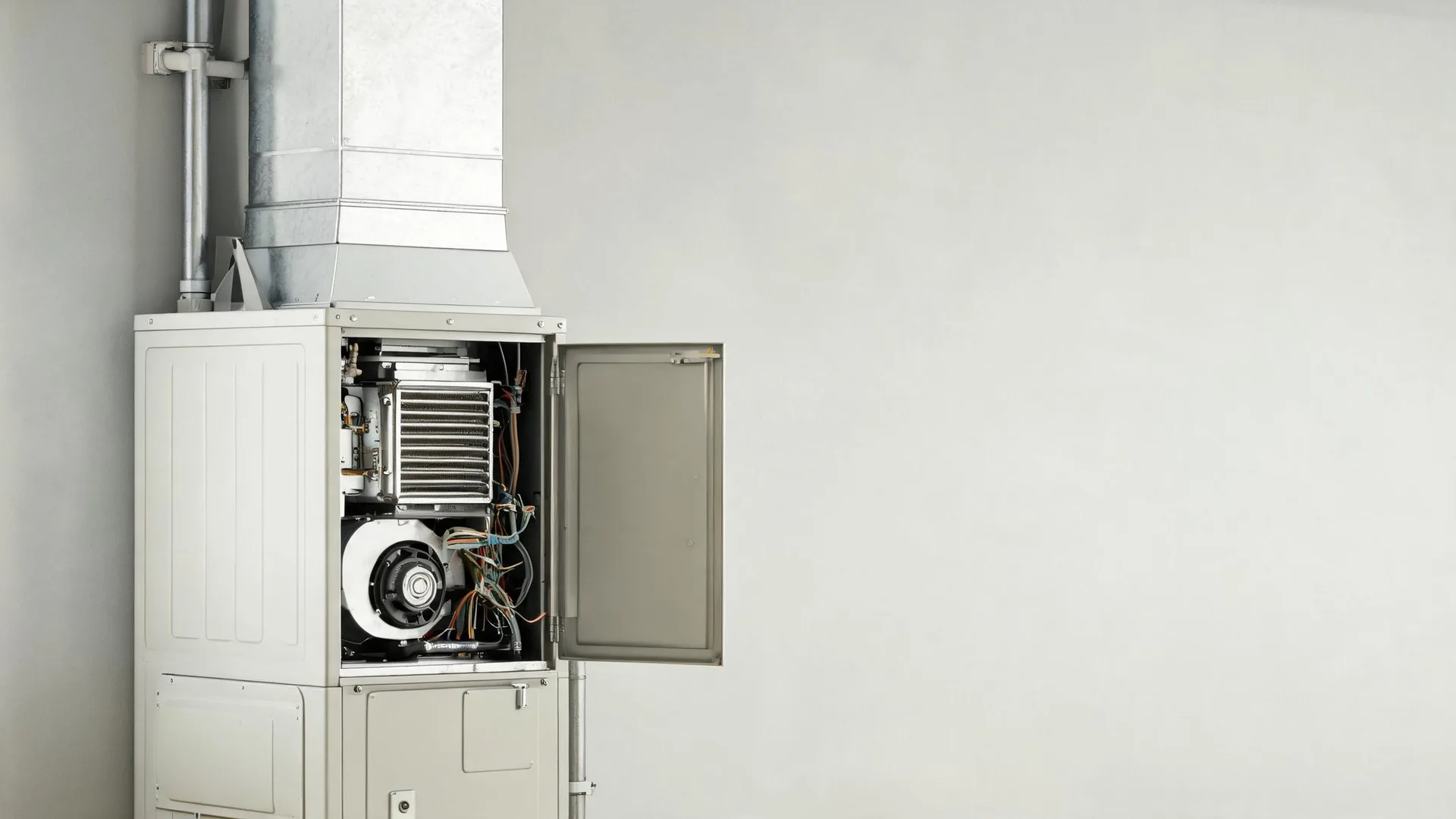
When an igniter is weak, the furnace tries again and again to get a flame going, and each failed attempt is the blower motor starting and stopping along with it. A motor that's cycled like that hundreds of extra times wears out sooner than it should have.

Most furnace trouble shows up while the system is still running, not after it quits. It cycles on and off faster than it should, never quite reaching the set temperature before it shuts down again. Air comes out of the vents but it's cool, which usually means the burners aren't lighting even though the blower is going. Some units click or try to start, go quiet, then try again a few seconds later. That's the igniter attempting to light and failing. A burning or dusty smell the first time it fires after sitting idle is normal and clears fast. A smell that lingers, or one that's sharp or scorched, is not. Listen too for a new rattle, squeal or grinding from the blower compartment, especially right when it kicks on. Any of these is worth a call before the furnace stops working rather than after.

A diagnostic visit starts before any panel comes off, with the contractor asking what the furnace is doing and when. Short cycling, cool air, a new noise, a smell, all of it narrows things down before a tool comes out. The panels come off next, and the igniter gets checked for a steady glow and a solid read, since a weak one still glows but can't hold up under load. The flame sensor gets cleaned or tested, because a sensor coated with residue reads no flame even when one is burning. Pressure switches and safety limits get checked too, since either one can shut the furnace down and mimic a different problem entirely. The heat exchanger gets a visual check for cracks, which matters most because a cracked one is a safety issue, not a comfort one. By the end, the part that's actually failing is known, not guessed at, and that's what gets replaced.