Limit switch trips below freezing
A furnace that shuts itself off on the coldest mornings is overheating before it should. Left alone, that pattern tends to get worse as temperatures keep dropping.

A furnace that short cycles, blows cool air, or trips its limit switch on the coldest mornings is telling you it won't make it through a Utah winter. Watch for the burner flame too: it should burn blue, and yellow or flickering flame means it isn't burning gas cleanly. A cracked heat exchanger, a failing igniter, or a blower motor that struggles to start are common reasons furnaces quit in January rather than October. Winters here push a furnace to run for hours at a stretch, night after night, and a unit that's already weak doesn't get a break to recover the way it might in a milder month. If yours is making noises it didn't used to make, cycling on and off more than it should, or leaving some rooms cold while it runs constantly, those are signs the system is losing the fight before the season even peaks. Catching this now, before a hard freeze, means the people counting on that heat aren't the ones who find out it failed.




A furnace that shuts itself off on the coldest mornings is overheating before it should. Left alone, that pattern tends to get worse as temperatures keep dropping.
A blue flame means clean combustion. Yellow or flickering means the gas isn't burning right, and that's worth having looked at before the cold settles in for good.
Winter nights average 21°F across Utah, per NOAA. That's well below freezing for hours at a stretch, and it's when a weak furnace shows itself. A unit that's struggling won't just run longer to keep up, it'll cycle on and off more, pushing cool bursts through the vents before the air warms back up. You'll feel it most in the rooms farthest from the furnace, and you'll notice the thermostat climbing slower than it used to. A furnace in good shape holds steady through a night that cold. One that can't is telling you something before it fails outright.
NOAA nClimDiv 1991-2020 county normals weighted by homes
You notice it in small ways first. A room near the vent stays cold no matter how long the furnace runs. The air coming out feels lukewarm instead of warm. The furnace clicks on, runs for a few minutes, then quits and starts again a short while later. Maybe you hear a rattle or a bang when it fires up that wasn't there last year. The gas bill climbs higher than it did the winter before, even though nothing in the house changed. On the coldest nights, the thermostat says 68 but the house feels closer to 60. None of this means the furnace is finished, but it does mean something inside it is working harder than it should, and a furnace that struggles in November usually fails outright in January.
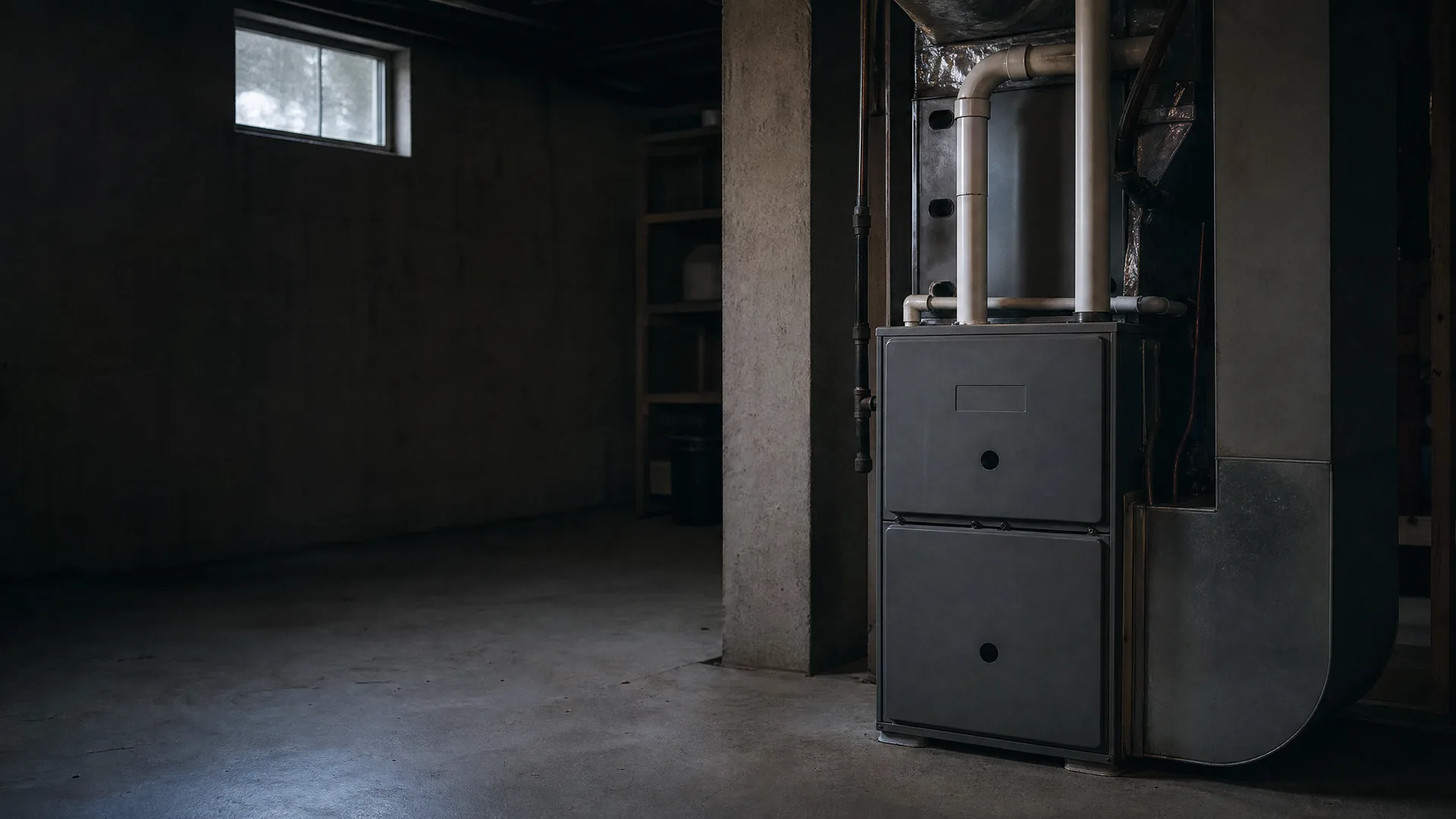
You go down to check the thermostat setting and the basement is quiet. The furnace sits dark, no hum from the blower, no blue glow through the vent. It's November, almost seven, and the cold has already settled into the concrete floor. You crouch by the unit and catch a thin haze of dust hanging in the air near the burner compartment, stirred up by a cycle that didn't finish. Upstairs someone asks why it's gotten chilly. You flip the switch on the side, wait, and nothing happens. Outside the temperature is dropping toward the 20s, the way it does most nights this time of year, and the house will feel it soon.
Describe what your furnace is doing once, in one form.
You only hire the pro if you want to.
Turn the thermostat up and a sequence starts, in order, before any heat reaches the vents. The inducer motor kicks on first, clearing the heat exchanger of old exhaust. The igniter heats up or sparks. The gas valve opens. The burners light. Only then does the blower start pushing air, and it waits on purpose, because air moving across a cold heat exchanger would just blow cold air into the house. A flame sensor is watching that whole process. It's a small rod sitting in the flame path, and its job is to confirm the burners actually lit. If it doesn't sense flame within a few seconds of the gas valve opening, the control board shuts the gas back off rather than let it keep flowing unlit. A furnace that fires, runs briefly, and shuts off is often doing exactly that: the sensor is dirty enough that it can't read the flame reliably, or the filter is clogged enough that airflow is choked and the system shuts down to protect itself. Neither points to the burners being at fault. The limit switch works differently. It reads the actual temperature inside the heat exchanger and cuts the burners if that temperature climbs higher than the system is built to handle. Normally that only happens with blocked airflow. But a crack in the heat exchanger traps heat in a spot that isn't supposed to hold it, and that same limit switch will trip from that too.


Thermostat calls for heat and signals the control board
Inducer motor starts to clear the heat exchanger of air
Igniter heats up or sparks to prepare for ignition
Gas valve opens and burners light off the igniter


At 21°F, a furnace in good shape still holds a steady temperature through the night. One that can't keep up will run long stretches without catching up, or shut off before the house warms. That gap is what to watch for.
NOAA nClimDiv 1991-2020 county normals weighted by homes

This furnace sits on a dry basement floor with its PVC drain pipes intact and the gas line secure. A unit set up like this fires, heats, and shuts off the way it's supposed to, night after night.

This furnace connects to older galvanized ductwork and a cabinet with a louvered panel, the mark of a mid-efficiency unit. That setup can still run fine, but it has less room to spare when a January night pushes hard.
You've noticed the furnace clicking a few times before it finally catches, sometimes not catching at all on the first or second try. It's the kind of thing you might have shrugged off in October, but now that mornings are dropping into the 20s, you want to know if it's a small thing or a sign the furnace is on its way out.
The igniter has to get hot enough, or spark strong enough, to light the gas the instant the valve opens. If it's wearing out, it can't always do that on the first attempt, so the control board cuts gas to the valve and tries the whole sequence again. A dirty flame sensor causes the same stall from the other end: the burners light, but the sensor can't tell, so the board shuts things down and restarts. Either part can keep working for a while this way. The trouble is a Utah morning at 21°F doesn't wait for three or four tries. Each failed attempt is heat the house isn't getting while the furnace sorts itself out.



This furnace sits connected and tight: sheet-metal ductwork, copper piping, a sealed PVC flue, a secure gas line. Nothing rattles loose, nothing vents where it shouldn't. A setup like this moves heat through the house steadily, even when it's 21°F outside at three in the morning.

Same basement, same galvanized ductwork, but something's off. A furnace like this often runs longer to put out the same heat, or shuts off before the rooms upstairs catch up. By the time you notice it on a cold morning, it's already been struggling for a while.

A furnace that short cycles, trips its limit switch, or lights with a yellow flame has already told you what it's going to do in January. It won't fix itself once the nights get colder. The question isn't whether it holds up through a Utah winter, it's whether you deal with it now or at 2 a.m. with the house at 55.
Getting someone out to look at it is the part most people put off, calling around, explaining the same symptoms three times, waiting on quotes that don't match up. Answer a few questions about what your furnace is doing and a contractor who handles this in your area will reach out to you directly, so the next call you make is the one that actually gets it fixed.

Asking costs nothing, and the choice to hire stays yours.
A furnace that's struggling in November won't hold up through a stretch of 21°F nights. Getting it looked at now means one call instead of searching around, explaining the symptoms twice, and comparing quotes on your own. You get matched with a contractor who reaches out to you directly.