Warmly lit timber-frame and stone houses line a street at dusk, with evergreen trees and a snow-capped mountain range in the background.

Heat Pump Repair in Salt Lake City, UT

Tell us about the job

Takes about a minute. No obligation.

RepairHeat PumpSalt Lake County, UT
Step 1 of 2

What ZIP code is the job in?

September is when a weak heat pump shows itself

Heat here runs October through May, about eight months straight. When the heat pump starts that stretch, whatever was already marginal in it has to carry a real load. A worn part that coasted through summer often fails in the first cold weeks of the season.


Get it looked at before the load hits

A heat pump acting up in September is easier to diagnose than one that has been running daily since October. Waiting until the system is already carrying the winter load means the same repair, but on a unit that has to keep working while it gets fixed.

8 months
October through May, your system heats
3 months
June through August, it cools
22°F
the average winter night it heats against
83°F
the average summer afternoon it cools against
Isometric cutaway illustration of a single-story house showing interior rooms, ceiling ductwork, an indoor air handler, and an outdoor condenser unit connected by lines on the ground.
Your system heats October through May and cools June through August.

NOAA nClimDiv, 1991–2020 normals

Salt Lake County gets winter storms, hail and damaging wind most years, same as a lot of places.

None of that is why your heat pump is struggling. It's almost always a worn part or a refrigerant issue, not the weather.

Half the homes here were built in 1986 or later, so the heat pump that came with yours probably still has years in it

Half the homes here were built by 1986
194 damaging wind events from 2015 to 2024
29 hail events from 2015 to 2024
Salt Lake City weather isn't why your heat pump is struggling314 severe weather events hit Salt Lake County between 2015 and 2024. That's normal for this part of the country.

Electricity in Utah ran 12.22 cents per kilowatt-hour in 2024. That's what a heat pump here runs on, same as every other appliance in the house. A heat pump that's losing efficiency usually doesn't trip a breaker or shut off on its own. It just runs longer to do the same job, and the bill goes up before anyone notices the airflow is weak or a room isn't holding its temperature. A dirty coil, a low refrigerant charge, a failing compressor all start out looking like a higher bill. Worth checking before the system has to carry a full winter load.

A system this age is usually worth repairing, not replacing

If your heat pump came with the house, there's a good chance it's not old enough to be the problem. Get the actual cause diagnosed before deciding it's time to replace anything.

Find a contractor
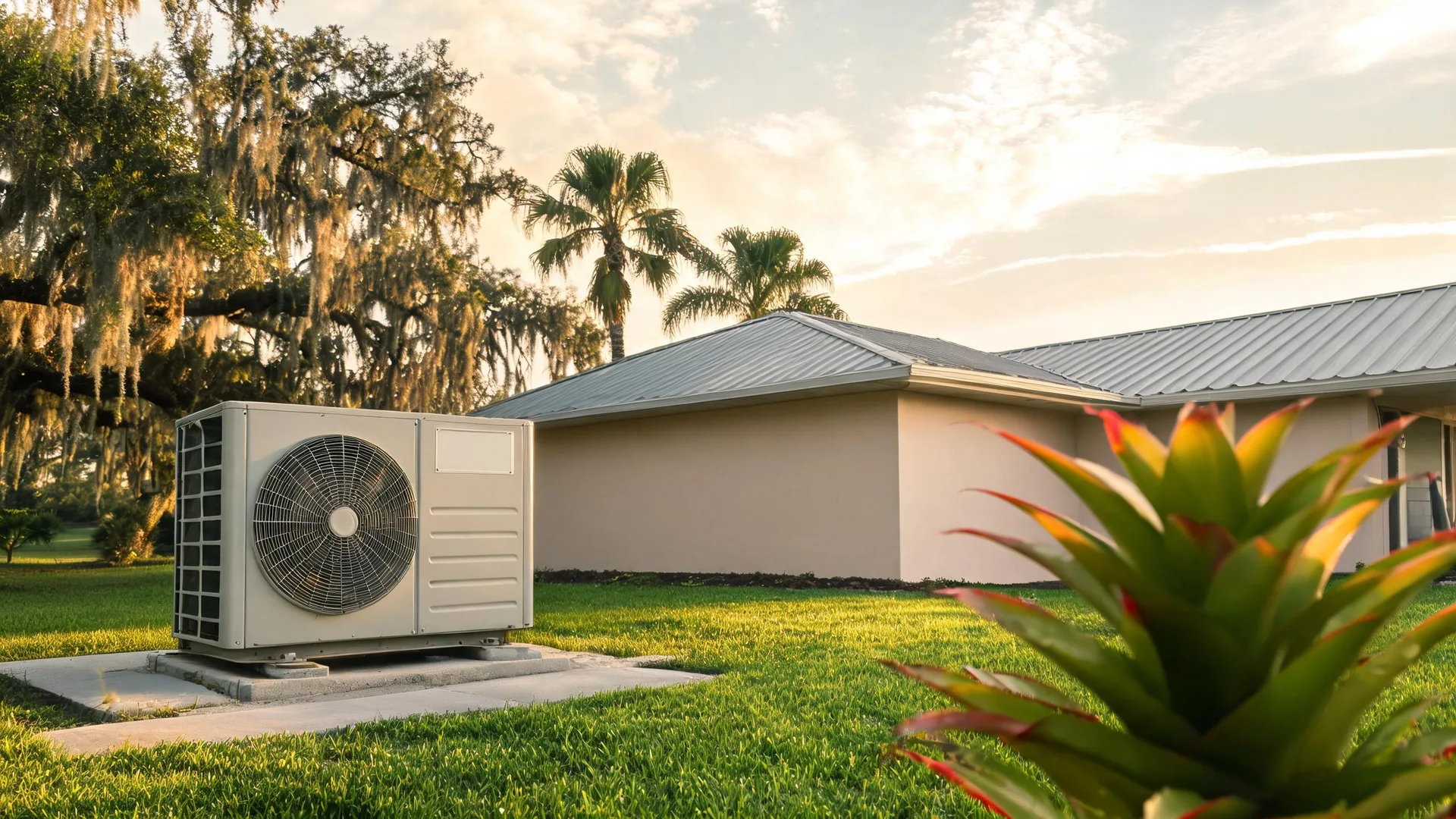
A gray air-source heat pump mounted on a concrete pad next to a house with gray vinyl siding, surrounded by gravel and flanked by green shrubs and white hydrangea flowers.

What to check yourself before the tech shows up

Before anyone comes out, check the thermostat first. Make sure it's set to heat, not cool, and the set point is actually above room temperature. Next, go look at the outdoor unit. If the coil is caked in leaves, dirt or ice beyond a thin frost layer, that alone can choke airflow and make the system struggle. Check the air filter inside. A filter clogged with dust forces the system to work harder and can freeze the coil over time. Walk the vents in the house and feel for airflow at each one. If one room is cold and the rest are fine, that points to a duct or damper problem rather than the heat pump itself. Look at the outdoor unit's fan. If it's not spinning at all while the system is calling for heat, that's worth noting for the tech. None of this tells you exactly what's wrong, but it rules out the easy stuff and gives whoever comes out a better starting point.

The reversing valve is the part unique to a heat pump

A heat pump has one part a straight AC doesn't have. The reversing valve switches it between heating and cooling. When that valve sticks, the system can get stuck cooling the house when it should be heating it, or it stops switching modes at all. It fails more often than people expect just because nothing else in the system does that job.

A refrigerant leak shows up as reduced heat, not no heat

Low refrigerant charge doesn't usually shut a heat pump down. It keeps running, just with less heat coming out of the vents. The outdoor coil may frost over because the system can't absorb heat properly anymore. A unit that runs constantly but never quite warms the house is often low on charge rather than broken outright.

Most heat pump calls start with something the homeowner noticed, not something they diagnosed. Air coming out of the vents feels cool instead of warm, even though the system is running. The outdoor unit is iced over well past a thin frost. The system switches on and off more than it used to, or it runs constantly and the house still doesn't feel right. Sometimes it's a sound. A clicking at startup that wasn't there before. A hum with no fan movement. Any of these is worth a call. None of them tells you on its own whether it's a quick fix or something bigger, and that's for whoever comes out to find, not something to guess at beforehand.

A diagnostic call starts outside at the unit, not inside with a clipboard. The tech checks refrigerant pressure first, because that one reading points toward or away from most of the other problems a heat pump can have. They'll run the system in heat mode and watch how the reversing valve responds, since a valve that hesitates or sticks shows up right away under load. Electrical connections get checked next, along with the capacitor and contactor, parts that wear out quietly and cause symptoms that look like something else entirely. If the coil is frosted, the tech wants to know whether it clears on its own during a defrost cycle or just keeps building, because that difference separates a charge problem from a control problem. Only after all of that does the conversation turn to what it'll take to fix it.