


A twilight street scene featuring illuminated timber-frame and stone houses with a mountain range visible in the background.

Heat Pump Repair in Morgan, UT

Tell us about the job

Takes about a minute. No obligation.

RepairHeat PumpMorgan County, UT
Step 1 of 2

What ZIP code is the job in?

Heat pumps here work almost year round, covering both heat from September through June and the one month of cooling in July. That long stretch means a weak part usually gets found in August, right before heat starts, or in June, right before the switch to cooling. A capacitor or contactor that was barely getting by can't keep up once the system is asked to run flat out. If your heat pump is struggling now, it's worth having someone check it before the next season change asks more of it.

10 months
September through June, your system heats
1 months
July through July, it cools
17°F
the average winter night it heats against
78°F
the average summer afternoon it cools against
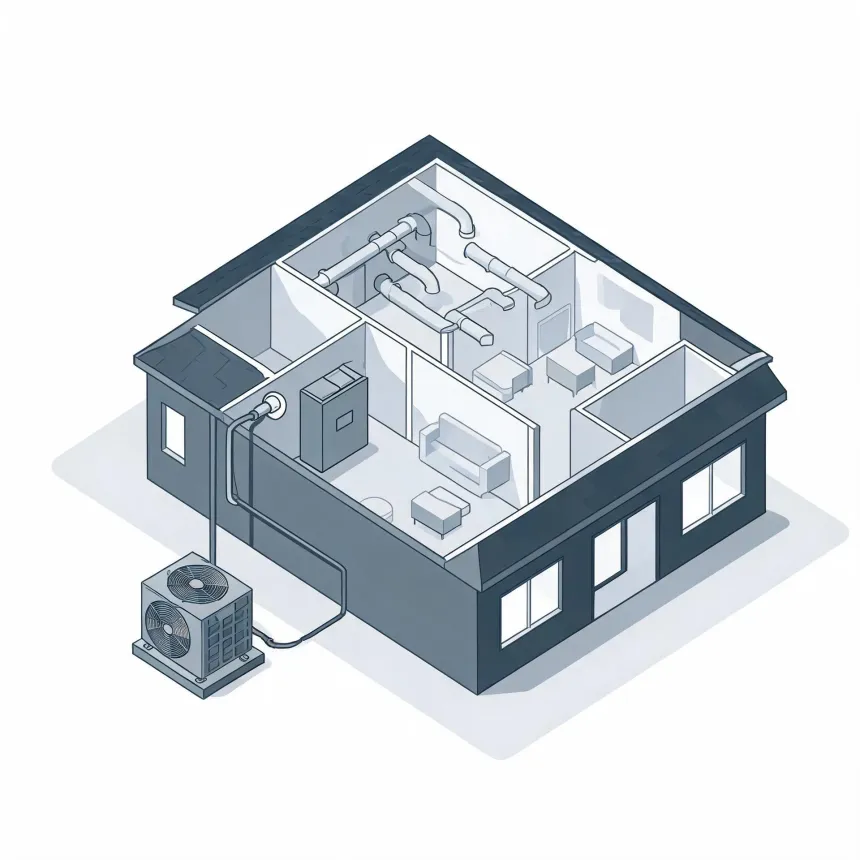
Isometric line illustration of a cutaway single-story house showing interior rooms, ceiling ductwork and an indoor air handler, connected by a line to an outdoor condenser unit on a pad beside the building.
Your system heats September through June and cools July through July.

NOAA nClimDiv, 1991–2020 normals

Morgan County gets down to 17°F on a typical winter night, and your heat pump is built to run right through that.

When it won't keep up, the cause is almost always a worn part, not the cold.

Get it looked at early

Problems tend to show up in the first weeks of the season, when the load hits a part that was already weak.

Find a contractor
A man in a cap, dark long-sleeved shirt and tan work pants, seen from behind, carries a canvas tool bag up concrete steps toward a dark blue front door flanked by white columns and a potted shrub.
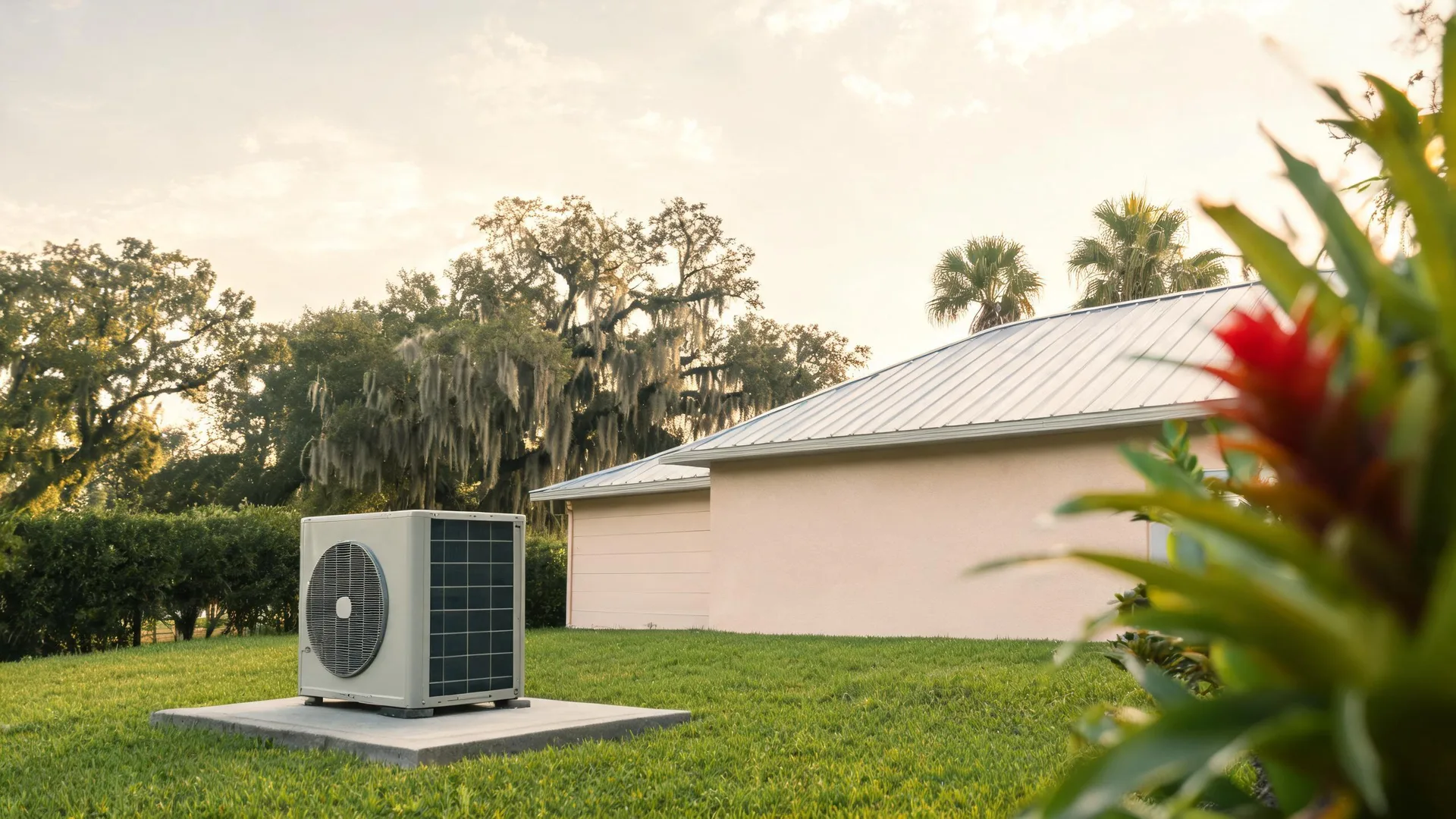
A residential heat pump outdoor unit mounted on a concrete pad next to a house with gray vinyl siding.

What actually wears out in a heat pump

The reversing valve is the part most specific to a heat pump, and it's often the one that causes trouble first. It's what switches the system between heating and cooling, and a valve that sticks will leave you with heat when you want cooling, or no heat at all. The defrost board and sensor are next. They tell the unit when to melt frost off the outdoor coil, and when that sensor reads wrong, the coil either ices over or the system runs defrost cycles it doesn't need. A heat pump also logs more run hours over a year than a furnace or an AC alone, since it's doing both jobs. That shows up first in small parts, a capacitor losing its charge, a contactor pitting at the contacts, long before it means anything for the compressor itself. Most of what fails is one part doing exactly what worn parts do, and swapping it is usually enough.

What you can check yourself

Look at the outdoor unit and clear away any leaves, snow or ice built up around it. Check the air filter and swap it if it's dirty, since a clogged filter chokes airflow and can make the whole system struggle. Check your thermostat has power and is set to the mode you want. Look at the outdoor coil for a heavy coat of ice that isn't melting off on its own, that's worth noting before anyone comes out.
What to leave alone

Don't open the outdoor cabinet or touch the wiring behind it. Don't try to force a reversing valve or clear ice off the coil by hand. If the system is running but blowing air that isn't warm or cool enough, that's a sign of a failing part inside, not something a homeowner can diagnose by looking. Flip the breaker off if you hear grinding or smell something burning, and wait for a tech instead of guessing further.

A heat pump that's struggling will keep trying anyway, and that's where the damage piles up. A low refrigerant charge is a good example. The system still runs, still moves air, but the compressor works harder to do less, and heat builds in it that the refrigerant is supposed to carry away. Keep that up long enough and a charge that needed topping off turns into a compressor that needs replacing. Ice on the outdoor coil is the same story. A little ice and the system still moves some air past it. Left running, the ice thickens, airflow drops further, and the compressor can end up pulling in liquid refrigerant instead of gas, which it isn't built to handle. Caught early, it's a small fix. Left running, it isn't.

A diagnostic call starts outside, at the unit itself. The tech checks refrigerant pressure, amp draw on the compressor and fan motor, and whether the reversing valve actually switches when it's told to. Inside, the cover comes off the air handler to look at the defrost board, the sensor, and the wiring between them, since a loose connection can mimic a bad part. Systems that blow cold air in heating mode can have different causes behind them, and the only way to tell them apart is to test each part in order rather than guess from the symptom. By the end, the tech should be able to point to the one part causing the trouble, not just describe what the system is doing wrong.