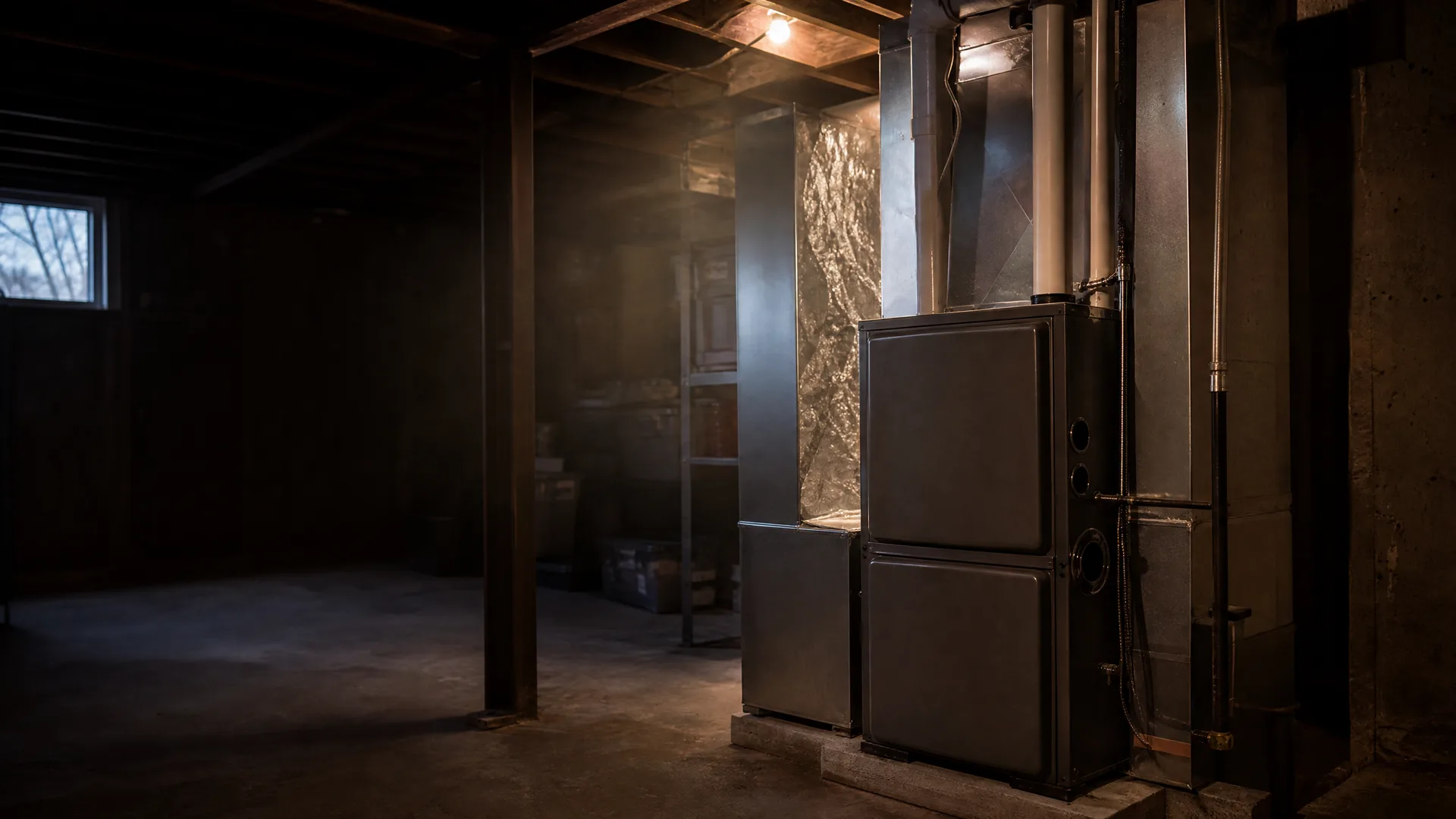
A gray high-efficiency furnace with two white PVC vent pipes stands beside galvanized sheet-metal ductwork in a dim basement with exposed joists and a concrete floor.

Find a furnace repair pro in Cache County

Furnace pilot light won't stay lit in Logan, UT

A pilot that won't stay lit usually comes down to the thermocouple, a draft in the furnace room, or dirt in the gas valve. Cold winters in Cache County mean you don't want to guess at this one. This page gets into what's likely going on, and can connect you with a local contractor who works on furnaces like yours all winter.

Request a pro

A pilot light that won't stay lit almost always means the thermocouple has gone bad. That's the small rod that sits in the pilot flame and tells the gas valve it's safe to keep sending gas. When it wears out or sits slightly out of position, it stops sensing the flame correctly, and the valve shuts the gas off as a safety measure, even though the pilot was burning fine seconds before. A draft in the furnace closet can do the same thing by blowing the flame around enough that the thermocouple reads it as out. Less often, the gas valve itself is failing, or the pilot orifice is dirty and starving the flame of gas. With Logan winters running long and cold, a furnace that keeps dropping its pilot is one to get looked at rather than relit over and over, since each restart is a sign the part causing it hasn't been fixed.

A gray furnace with white PVC vent pipes stands beside sheet-metal ductwork in a basement with a smooth concrete floor, exposed wood framing, and plastic sheeting on the walls.

Pilot holds steady

The flame burns steady, blue, and wraps the thermocouple tip the way it should. The furnace fires when the thermostat calls and keeps running through the cycle. No rust on the cabinet, no gas smell near the valve, no draft sneaking past the access panel to blow the flame sideways.

A beige furnace with two access panels stands against a concrete basement wall, with galvanized sheet-metal ductwork, a white PVC pipe, flexible conduit and insulated ducting around it.

Pilot keeps going out

The flame lights, then drops out within seconds or minutes, often right as the burners try to kick on. Rust shows on the cabinet and near the pilot assembly. A gas smell may hang around the valve, and the flue pipe up top is doing its job of exhausting even when the pilot itself won't hold.

Keep relighting the pilot and it keeps going out?

You've probably relit it two or three times now, holding the knob down and waiting, only to have it go dark again an hour later or the next time the thermostat calls. Maybe you've noticed the flame looks small or yellow instead of a steady blue, or there's a faint gas smell near the valve when you crouch down to check it. Some nights the furnace doesn't fire at all, and the house is colder than it should be by morning. Left alone through a Cache County winter, a pilot that won't hold means heat you can't count on, and a furnace room worth checking for what's actually causing it.

A dimly lit basement with exposed joists, steel support posts and a concrete floor, with a furnace and metal ductwork along the right wall and a small window at the far left.

You're down in the basement around six, the sky already dark outside the window well. You'd gone down to check why the house felt cool, and the furnace sits there dead, no flame, no hum. Dust hangs faint in the air where the access panel's been pulled off and set against the wall. You strike the igniter button again, hold it the way you did last week, and watch the pilot catch, blue and small. You count to thirty like the sticker says. The second you let go, it's gone again. Outside, Cache County is settling into another November freeze, and you're crouched by a cold furnace with a lighter in your hand, out of ideas for tonight. You'll want someone who knows this furnace's quirks to look at it before the cold really sets in.


The right pro for this job

A bad thermocouple doesn't fix itself with another relight, and a furnace that won't hold a pilot through a cold night in Cache County isn't something to leave for the weekend. Someone who works on furnaces around Logan all winter has seen this exact failure dozens of times this season alone, on the same handful of brands sold here, and knows within a few minutes whether it's the thermocouple, a draft pulling the flame off it, or dirt fouling the gas valve. That's different from guessing room by room with a lighter and a prayer. Getting matched here puts the job in front of one licensed local contractor, not a handful of companies bidding for your number, so the person who calls you is the one who'll actually show up and look at your furnace. With the temperature dropping outside and a pilot that won't hold, that's worth setting up now rather than after another cold night without heat.

Why the thermocouple fails first

The thermocouple sits in the pilot flame day after day, all winter, every winter. It's a simple part, a thin metal rod wired to the gas valve, and heat cycles wear it out over years of use. Once it weakens, it can still read the flame when things are calm, but a draft or a slightly low flame is enough to make it lose contact and shut the gas valve down. That's why the pilot can hold for a day or two, then quit again. It's not failing all at once. It's failing a little more each time you relight it.

Why a draft makes it worse

A furnace room isn't sealed off from the rest of the basement, and cold air finds its way in around a door, a window well, or a vent that wasn't meant to pull air that direction. Cache County winters bring wind along with the cold, and that wind can push just enough air past the pilot to bend the flame off the thermocouple tip. A thermocouple that's already marginal won't tolerate that. One that's in good shape usually will. That's part of why two furnaces with the same symptom can have two different causes.

A woman in a cream turtleneck sweater stands beside a large window with snow outside, looking to the side, in a dimly lit living room with a sofa, lamps, candles and framed artwork.
A woman in a light gray cable-knit turtleneck sweater stands by a window looking outside at snow, with a living room behind her containing a stone fireplace, lit lamp, framed pictures, and a sofa with a plaid throw.
A woman in a dark gray turtleneck sweater stands by a window with snow visible outside, in a dimly lit living room with a gray sofa, lamp, framed painting, and dark-framed glass door.
A woman in a cream turtleneck sweater stands by a window looking out at falling snow and snow-covered trees, with a dimly lit living room containing a sofa, lamp and fireplace behind her.

Thermocouple replaced

A new thermocouple holds the pilot steady through the whole heating cycle. The flame stays blue and wrapped around the tip, night after night, without you touching the knob.

Find a licensed furnace pro

Pilot kept relighting

Relighting it again buys you an hour, maybe a night, before it goes dark again. Nothing's actually fixed, and you're back down in the basement in the cold to do it over.

Find a licensed furnace pro

Why does a Cache County furnace lean so hard on one part?

  • Winter nights average 17°F

    Overnight lows average 17°F here in December, January and February, so the pilot has to hold through the coldest hours without you watching it.

  • Heat runs September through June

    Furnaces here run from September through June, about ten months of the year, so the thermocouple cycles on and off far more than in most places.

  • 80.9% of homes heat with gas

    80.9% of homes in Cache County heat with gas, which means most of your neighbors depend on this same small part doing its job night after night.

NOAA nClimDiv 1991-2020 · ACS 2020-2024

A woman stands smiling in the open front doorway of a single-story brick house while a man in a dark cap and long-sleeved shirt, seen from behind out of focus, faces her from the walkway.

A pilot that won't hold is a thermocouple problem, most of the time

The flame goes out because the thermocouple isn't telling the gas valve the pilot is lit anymore. Relighting it buys you an hour, maybe a night, but it keeps happening until the part gets replaced. That's where you stand right now, and it's a fair place to stand. Nothing about this means the furnace itself is failing.

Someone who works on furnaces around Logan every winter has pulled this part more times than they can count, usually off the same handful of furnace models that show up again and again in this area. Get matched with a local contractor who does this work and they'll call you directly, no string of companies competing for your number. You'll have one person to talk to about what they find when they open the cabinet, and one person who stands behind the fix.

A gray upholstered sofa with a beige cushion and knit blanket beside a curtained window, with a white mug and a book on a dark wooden table in the foreground and a lit lamp in the background.
A bearded man in a plaid flannel shirt over a gray tee looks out a frosted multi-pane window with snow outside, a steaming dark mug on the sill beside him and shelves of dishware behind.
A bearded man in a dark gray T-shirt sits smiling on a light gray couch, with a houseplant and a framed picture on the wall behind him.

Furnace Repair

A furnace pro near you

A licensed pro who works in Cache County gets your request.

A black-framed smartphone standing upright against a plain light gray background, its screen filled with solid green.
RepairFurnace or heatingCache County, UT
Step 1 of 2

What ZIP code is the job in?