Furnace leaking water in St. George, UT

Get matched

Water pooling under your furnace or dripping from the ductwork is not something to leave alone, especially with a Washington County winter ahead. It might be a condensate line that is clogged, a drain pan that has rusted through, or something going on with the venting. Whatever it is, it is not the kind of thing you want to diagnose yourself on a cold morning. This page connects you with a contractor who takes on furnace trouble like this in St. George and the surrounding area. Fill out the form and the search is off your plate. No more sorting through listings or guessing who actually answers their phone. A contractor who covers your part of Washington County gets your information and reaches out to you directly. Your job was finding help. That part is done once you send the form.

Why is water leaking from my furnace?

Water showing up around your furnace is unsettling, especially if you're not sure whether it's a quick fix or a sign of something worse. Most furnaces in St. George run on gas, and a gas furnace that's leaking water is almost always a high-efficiency model with a condensate line, which means the problem is usually in how that moisture drains, not a sign the furnace is failing outright.

A clogged condensate line is the most common cause

High-efficiency gas furnaces produce condensation as part of normal operation, and that water needs somewhere to go. It drains through a condensate line into a drain or pump, and if that line gets blocked with algae or sediment, the water backs up and finds its way out around the unit instead. A cracked drain pan or a disconnected line does the same thing. Less often, a dirty flue or a cracked heat exchanger can cause moisture to collect where it shouldn't. Either way, running the furnace with water pooling nearby isn't something to wait out through a Washington County winter, since the moisture can reach electrical components or the heat exchanger itself.

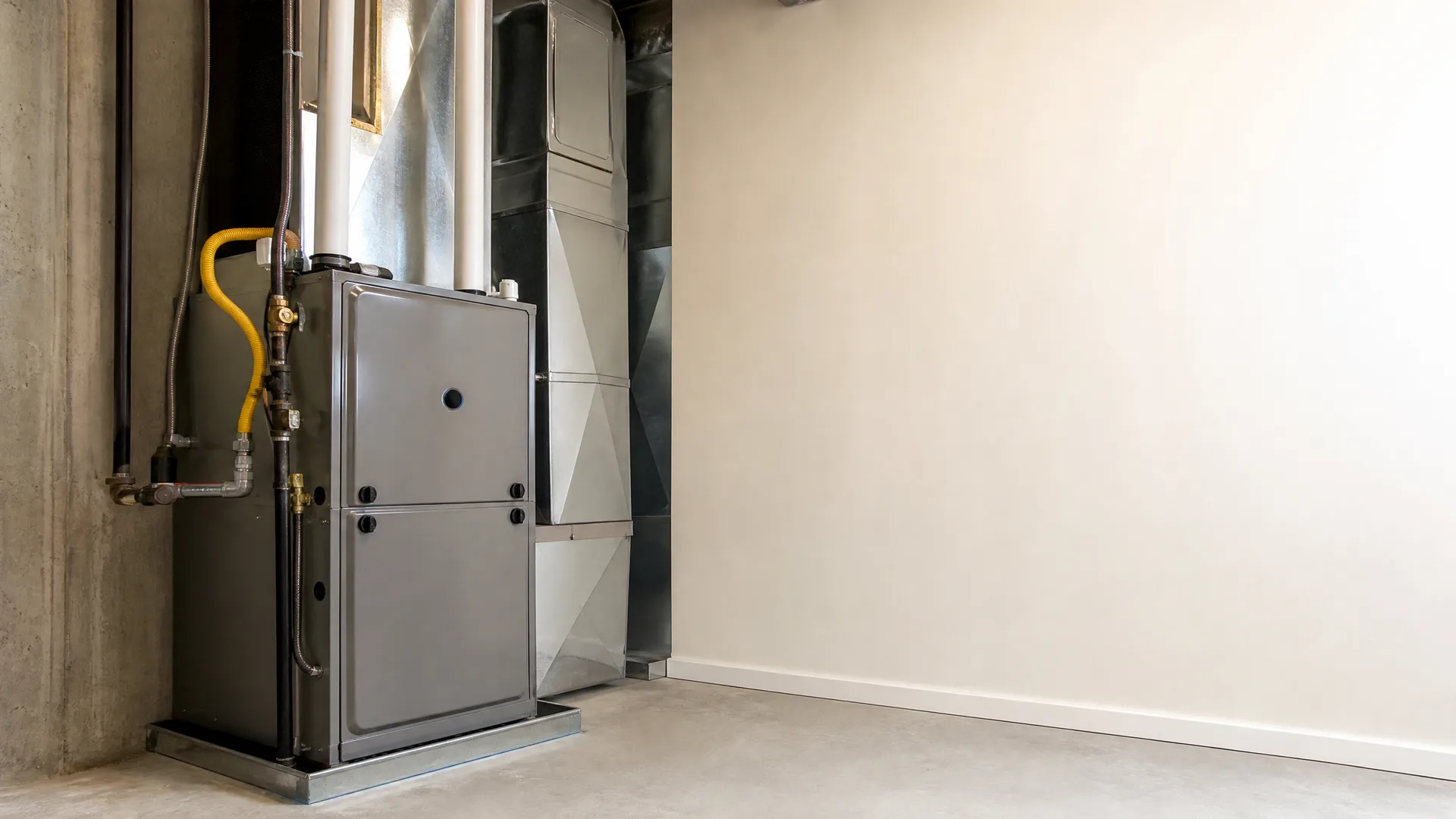
A gray gas furnace with attached yellow gas line, copper piping, white PVC vent pipes and sheet-metal ductwork stands against a wall in an empty basement room with a concrete floor.

Why the condensate line clogs

A high-efficiency furnace produces condensation as it runs, and that water has to drain out through a small plastic line. Over a winter of steady use, algae and sediment build up inside that line and slow the drip to a trickle, then stop it. Once the line backs up, the water has nowhere to go but out of the furnace cabinet or into the drain pan, and from there onto your floor.

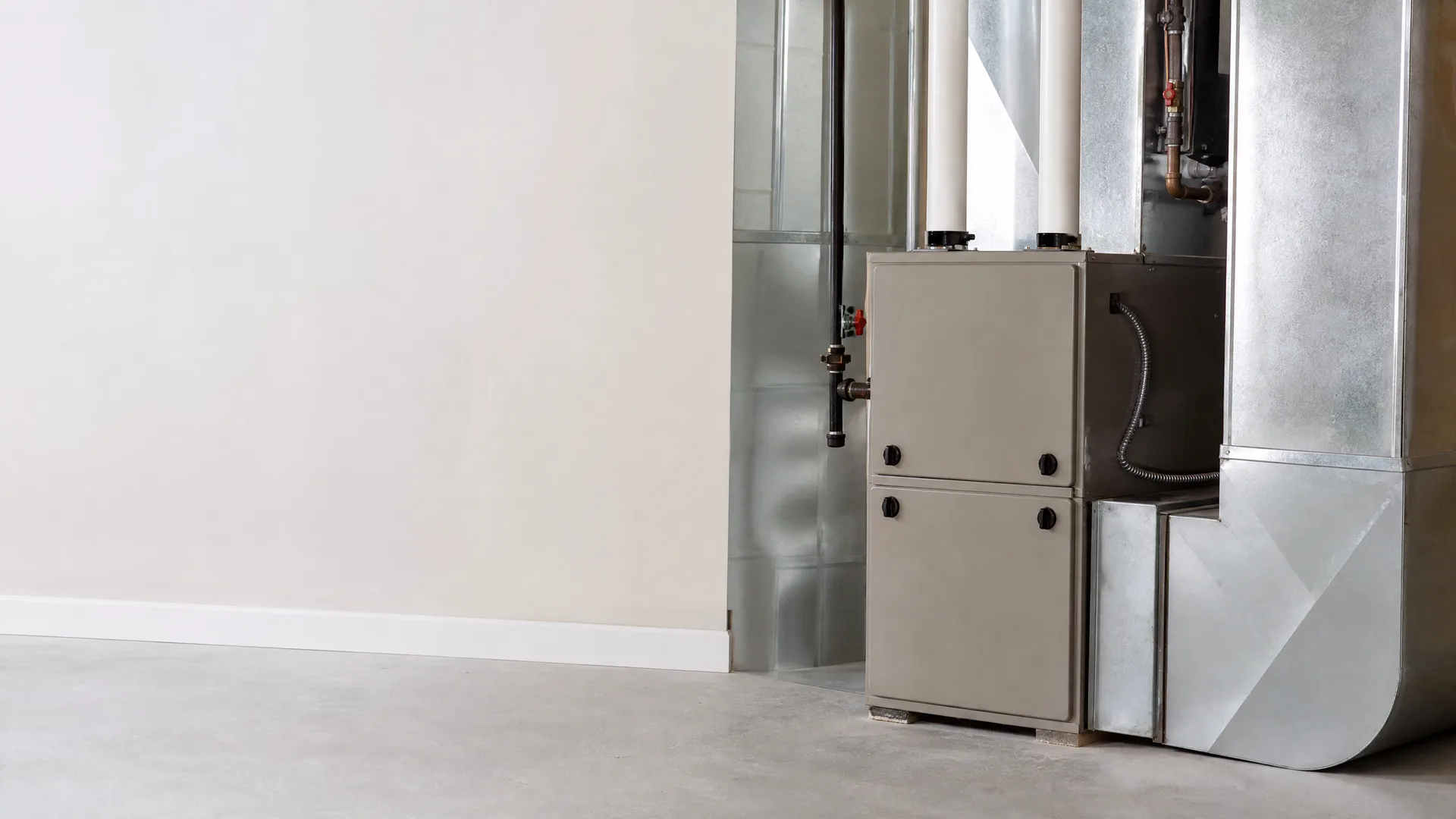
A beige high-efficiency furnace with white PVC vent pipes stands against a wall beside galvanized sheet-metal ductwork in an empty room with a concrete floor.

What a rusted pan tells you

The drain pan under an older furnace is usually metal, and metal rusts through after enough years of sitting wet. Once it has a hole, every bit of condensate finds its way through instead of into the drain line. A pan like that does not get patched back to new. If your furnace came with the house, it is worth asking whoever looks at it how old that pan actually is.

Why does my furnace's leak get worse as winter goes on?

  • Winter nights average 28°F

    Overnight lows in Washington County average 28°F through December, January and February, so your furnace runs long stretches to keep up, and a slow drip has more hours to turn into a puddle.

  • Heat runs October through May

    Furnaces here run from October through May, about eight months of the year. A condensate line that's narrowing has that whole stretch to go from a trickle to a full clog.

  • 58.1% of homes heat with gas

    58.1% of homes in Washington County heat with gas, and it's the gas furnace's condensate line and drain pan that are behind most of the leaks homeowners find.

NOAA nClimDiv 1991-2020 · ACS 2020-2024

The leak is from condensation

High-efficiency gas furnaces pull extra heat out of the exhaust, and that process turns part of it back into water. That water is supposed to run out through the condensate line into a drain. A little moisture around the unit while it's running is normal for this kind of furnace. The problem shows up when that water stops draining the way it should and starts collecting where you can see it, on the floor or along the ductwork. The furnace isn't doing anything wrong by producing the water. Something downstream of it is.


The leak is from a blockage or crack

If the condensate line is clogged with algae or sediment, the water backs up and finds another way out, usually the drain pan or a seam in the ductwork nearby. A drain pan that has rusted through will leak no matter how clear the line is. A cracked line does the same thing even with no blockage at all. These aren't things the furnace can clear on its own, and a drip that starts small tends to get worse the longer the furnace runs each night.

A gas furnace with a louvered upper panel stands on a concrete pad in a basement, flanked by sheet-metal ductwork, white PVC and metal pipes, and insulated columns.
Before you get your furnace repair
A dark high-efficiency furnace on a concrete pad in a basement, connected to galvanized ductwork, white PVC vent pipes, and copper and black gas piping, with concrete walls and wood framing nearby.
After you get your furnace repair

Get matched with a furnace pro in Washington County

After this form, you can stop searching for a furnace pro.

You only hire the pro if you want to.

What a stalled furnace means tonight

A gas furnace with a clogged condensate line will shut itself off rather than keep flooding the drain pan. That is a safety switch doing its job, not a part failing on its own, and it means no heat until the water problem is cleared. On a night when lows are in the 20s, that switch can trip more than once if the line is only partly blocked. You might get it running again by resetting the switch, and then watch it quit a second time an hour later. Each restart buys less time than the last if the clog is still there.

What the water touches on its way out

The drain pan sits under the furnace for a reason, and most of the time it holds. But a pan that has already rusted through, or a line that backs up faster than the pan can hold it, sends water onto the floor underneath. If your furnace sits in a closet, that means carpet, drywall or a wood subfloor taking on moisture it was never built for. In a garage or utility room the floor usually handles it better, but the water still has to go somewhere, and standing next to a gas appliance is not where you want it sitting.

A woman with dark hair in a bun sits on a beige sofa under a knit blanket with her eyes closed and an open book in front of her, with a lit lamp and houseplant in the background.
A smiling bearded man in a dark sweater sits at a dinner table with lit candles, a glass of red wine, and bowls of food, in a dimly lit room with a lamp and houseplant behind him.

The condensate line runs from the furnace to a floor drain or a drain pump, and most of it sits almost flat, so it only takes a small sag or a bit of buildup to stop the water from moving. Furnaces built in the last couple decades use a float switch sitting right in the drain line or the pan underneath it. When water backs up past a certain point, that switch tells the control board to shut the burners down. Some furnaces pair that with a secondary drain pan, a shallow metal tray mounted under the unit, there to catch overflow before it ever reaches your floor. If that pan is rusted through or cracked, water gets past the one safeguard built to stop it. A technician checking a leaking furnace traces the line from the unit to the drain, looking for a low spot holding water, a cracked fitting, or a pan that has given out, before ever touching the burners or the heat exchanger.

A smiling bearded man in a dark long-sleeved shirt sits on a brown leather sofa in a living room, with a large glass bowl of popcorn on a table in the foreground and a houseplant and doorway behind him.
A smiling man with gray-streaked hair and a beard in a dark blue sweater reclines on a sofa in a living room with a lit wood stove, shelves, wicker baskets and a bowl of popcorn on a table.
A smiling bearded man in a dark plaid shirt sits on a green couch beside a cushion and a wooden bowl of popcorn, with a blurred kitchen and living area behind him.
A smiling bearded man in a dark green henley shirt sits on a gray couch in a living room with a bookshelf, lit lamp, houseplant and framed picture behind him, and a bowl of popcorn in the foreground.
A beige high-efficiency furnace with white PVC vent pipes stands beside galvanized sheet-metal ductwork in a basement with a concrete floor, exposed wood studs, and metal piping along the wall.

Furnace running clean

No water on the floor, no drip at the ductwork seams. The PVC pipes running out of the furnace carry exhaust and condensate where they're supposed to go, and the drain line stays clear enough to keep up with it. This is what a furnace in Washington County should look like all winter.

An older beige furnace with a louvered vent panel stands on a concrete basement floor beside galvanized sheet-metal ductwork, a metal flue pipe and vertical pipes along a concrete wall.

Furnace backing up

Water is tracking down from the flue connection or pooling near the cabinet, and that cream-colored furnace has likely been running for years without the condensate line ever being cleared out. Algae and sediment build up slowly, and by the time you see water on the concrete, the line is already blocked.

Clogged Line or Failed Part

Clogged Line

  • A shop vac on the outside termination can sometimes pull the clog free in minutes without opening the furnace cabinet.
  • Vinegar flushed through the line dissolves algae buildup, and a lot of contractors carry this as their first move.
  • Once the line runs clear, the float switch resets on its own and the furnace fires back up right away.
  • This fix holds until sediment builds up again, which can be months away or could happen again by spring.
  • It costs less than opening up the furnace to get at the drain pan or the heat exchanger.

Failed Part

  • A cracked drain pan, a bad condensate pump, or a failed float switch won't clear with a flush and needs to be replaced.
  • A contractor has to pull panels and trace the line to find out if the problem is the part and not just the buildup.
  • A heat exchanger crack showing up as water, though rare, means the furnace needs more than a cleared line to run safely.
  • Parts like the condensate pump or float switch are specific to the furnace's make and model, so the right one has to be ordered or kept in stock.
  • This takes longer than a flush because the furnace has to be opened up and the failed part confirmed before anything gets swapped out.
  1. Exhaust gases cool as the furnace pulls extra heat from them.

  2. Cooling the exhaust turns part of it back into water.

  3. That water drips down into a condensate trap below the burner.

  4. The trap feeds a plastic line running to a drain.

Winter nights average 28°F

Nights in the high 20s mean your furnace is running most of the night to keep up, not cycling on and off a few times. That's more hours for condensation to form and more hours for a clogged line to drip before morning.

NOAA nClimDiv 1991-2020

Where This Leaves You

  • A furnace leaking water almost always means a clogged condensate line, a cracked drain pan, or a float switch doing its job.
  • The furnace shutting off on its own is the safety switch working, not a sign the unit is failing.
  • A clear condensate line and a clean drain pan stop the leak at its source instead of just drying up the puddle.
  • Cold nights in Washington County mean long run times, so a small clog turns into standing water faster than you'd expect.
  • A contractor can trace the water back to its source and get the furnace running again without guesswork.
  • Once you send the form, a contractor takes it from there and reaches out to you directly.

Water under the furnace has a cause, and it is one of a short list: the condensate line is clogged, the drain pan has rusted through, or the float switch has done exactly what it was built to do and shut the unit down before the water went further. None of that means the furnace is failing on you. It means a small path for water got blocked, and on a cold night with the furnace running for hours on end, a blocked path shows up fast as a puddle on the floor. Clearing the line and checking the pan stops the water where it starts, so the furnace can run the rest of the winter without you finding another puddle in a week. The alternative, mopping it up and hoping it doesn't come back, usually just buys a few days before the same drip returns, often at a worse spot in the line or with more water than before. A contractor who works on furnaces in Washington County can trace the leak back to where it starts, whether that's the line, the trap, or the pan itself, and deal with it directly instead of guessing at it. Once you send the form, that search is off your hands. A contractor who covers your area gets in touch with you, and from there it's a conversation about your furnace, not a project you have to manage alone on a night when you'd rather have the heat back on.

A dimly lit unfinished basement with concrete walls and floor, exposed floor joists, a small window at left, and a dark furnace with PVC venting and sheet metal ductwork at right.

A local pro for your furnace repair

One request and the search for a pro is handled.

RepairFurnace or heatingWashington County, UT
Step 1 of 2

What ZIP code is the job in?